
Watching someone you love struggle with addiction is one of the most agonizing experiences a family can ever endure. It is a journey often characterized by profound fear, endless sleepless nights, persistent worry, and an overarching sense of helplessness. When you are in the thick of it, the situation can feel entirely overwhelming and isolating. …


Watching someone you love struggle with addiction is one of the most agonizing experiences a family can ever endure. It is a journey often characterized by profound fear, endless sleepless nights, persistent worry, and an overarching sense of helplessness. When you are in the thick of it, the situation can feel entirely overwhelming and isolating. However, it is vital to anchor yourself in the truth that there is genuine hope for your family, and turning that deep pain into a shared purpose is entirely possible. Many families asks themselves if they should wait for a “rock bottom” moment, but the reality is that waiting often increases the risks.
According to a landmark 2020 study published by the Centers for Disease Control and Prevention (CDC) and the National Institute on Drug Abuse, 75 percent of people who experience addiction eventually recover. This statistic is a powerful reminder that recovery is not just a distant, vague possibility. It is a tangible reality for the vast majority of individuals who actively seek help. But, reaching that turning point is rarely a straightforward journey and it can be incredibly challenging without the right support and guidance. Addiction thrives in isolation and confusion, which is why professional intervention services in Texas, specialized treatment, and dedicated family involvement are critical components of a successful recovery journey. Having experts help navigate this complex and emotionally charged process truly makes all the difference in moving a loved one toward a healthier life.
If you have reached the point where an intervention is necessary, you are likely exploring the different methodologies available to facilitate this crucial conversation. Below, we will explore several well-known intervention frameworks, culminating in a detailed look at the ARISE model and how it contrasts with more traditional approaches.
Understanding the Importance of Intervention Models
When a family decides to take action, the choice of “how” they intervene is just as important as the decision to intervene itself. The method you choose sets the tone for the entire treatment process. If the initial conversation is rooted in shame or ambush, the individual might enter rehab with their guards up, making the clinical work much harder. Conversely, if the intervention is collaborative and transparent, the individual often enters treatment with a sense of agency and willingness.
For families specifically seeking drug intervention support in Austin, understanding the right model can make all the difference.
The primary goal of any intervention is to interrupt the cycle of self-destruction and move the individual toward a life-saving clinical resource. However, modern recovery science has shown us that the family needs just as much support as the person using substances. This is where the distinction between models becomes vital for long-term success.

Exploring Traditional Intervention Models
When families first begin researching how to stage an intervention, they often encounter a few established frameworks that have been used by professionals for decades. Understanding these traditional models helps illuminate why newer approaches, like the ARISE model, were developed as alternatives.
1. The Johnson Model (The Surprise Approach)
When most people envision an intervention, often because of how it is dramatically depicted in movies and television shows, they are picturing the Johnson Model. Developed in the 1960s by Dr. Vernon Johnson, this model was revolutionary for its time because it challenged the prevailing belief that an individual had to hit rock bottom before they could be helped.
The Johnson Model is characterized by secrecy and surprise. Family members, friends, and colleagues gather privately with an intervention specialist to plan the event without the knowledge of the person struggling with addiction. During the actual intervention, the individual is surprised by the gathered group. Participants take turns reading prepared letters that detail specific instances where the addiction has caused harm, expressing their love, and firmly outlining the consequences or bottom lines that will be enforced if the individual refuses to enter a designated treatment program.
While the Johnson Model can successfully break through denial and immediately transition a person into a treatment center, it has notable drawbacks. The element of surprise can trigger a severe fight or flight response. The individual often feels ambushed, cornered, or deeply shamed. This defensive posture can sometimes damage family trust, making the individual resistant to the therapeutic process even if they do ultimately agree to go to rehab. It’s important to remember that if a person feels attacked, they are less likely to listen to the logic of the situation.
2. The Family Systemic Model (The Healing Approach)
In stark contrast to the surprise-attack nature of the Johnson Model, the Family Systemic Model operates on the foundational belief that addiction is a family disease. This means that the addiction does not just affect the individual consuming the substance. It fundamentally alters the behaviors, roles, and emotional health of the entire family network.
In this model, there are no secrets and no hidden meetings. The individual struggling with addiction is invited to attend all meetings from the very beginning. The intervention is not viewed as a single, dramatic event meant to force the individual into treatment, but rather as a series of facilitated family therapy sessions. The primary goal is to heal the entire family unit. The interventionist works to identify enabling behaviors, improve communication, and establish healthy boundaries.
Even if the individual refuses to enter formal treatment, the family continues their own counseling and recovery process. By changing the family dynamic and refusing to participate in the cycle of addiction, the family inherently changes the environment, which often eventually encourages the struggling individual to seek help. This model focuses on the long-term wellness of the family system, ensuring that even if one person isn’t ready, the rest of the family can still find peace.
3. The Field Model (The Hybrid Approach)
Developed in the late 1990s, the Field Model was designed to be highly adaptable, combining elements of both the Johnson and Family Systemic models to suit the specific needs of the situation.
An interventionist using the Field Model will thoroughly prepare the family for a traditional, Johnson-style surprise intervention. However, they remain highly agile. If the individual reacts with extreme hostility or is deemed a flight risk during the confrontation, the interventionist can seamlessly pivot to a Family Systemic approach. This flexibility allows the professional to de-escalate volatile situations while still keeping the family focused on establishing boundaries and pursuing collective healing.
This model is particularly useful for families dealing with high-intensity situations where the risk of violence or immediate flight is a concern. It provides a safety net for the family while still pushing for an immediate decision regarding treatment.
The ARISE® Model: What Makes It Different?
While traditional models have their place, many modern recovery professionals and families prefer approaches that minimize confrontation and maximize collaboration. This brings us to the ARISE® model, which stands in profound contrast to the secretive nature of the Johnson Model. The ARISE® model is specifically designed as an invitational intervention.
Standing for A Relational Intervention Sequence for Engagement, the ARISE model removes the element of surprise entirely. Instead of planning behind closed doors, the family, guided by an interventionist, openly invites the individual struggling with addiction to join them in a collaborative meeting. This transparency is the cornerstone of the ARISE philosophy. By issuing an invitation rather than an ultimatum, the family extends respect and dignity to their loved one. It shifts the dynamic from us versus you to all of us working together against the addiction.
If the individual chooses not to attend the first meeting, the family still gathers with the interventionist to begin their own healing process and to plan the next open invitation. This phased approach is what makes the ARISE model so unique. It doesn’t rely on a single moment of high pressure. Instead, it builds a bridge of support that the individual can walk across when they are ready.
The Three Levels of ARISE®
The ARISE model is typically structured in three progressive levels, gently escalating the level of family involvement and boundary-setting only if the previous level does not result in the individual entering treatment.
- Level 1: The First Call and Initial Meeting. The process begins the moment a concerned family member calls an ARISE-trained interventionist. The interventionist coaches the family on how to invite the loved one to a meeting. Surprisingly, many individuals agree to attend this first meeting simply because they were asked with respect rather than cornered.
- Level 2: Strength in Numbers. If the individual does not agree to treatment after the first meeting, the interventionist brings in a larger group of the “Intervention Network.” This might include extended family, friends, or even employers. The focus remains on love and support, but the gravity of the situation is made clearer.
- Level 3: The Formal Intervention. This is only reached if the first two levels do not result in a commitment to treatment. At this stage, the family must set firm boundaries. However, because of the work done in Levels 1 and 2, the individual is rarely surprised by these boundaries. They have seen the family’s commitment to health and know that the old way of living is no longer an option.
Because it empowers the individual and treats them as an active participant in their own recovery journey, the success rates of this model are remarkable. Peer-reviewed data on the ARISE® invitational intervention shows that it successfully gets over 60 percent of individuals into treatment within the very first week, and about 83 percent eventually enter treatment.
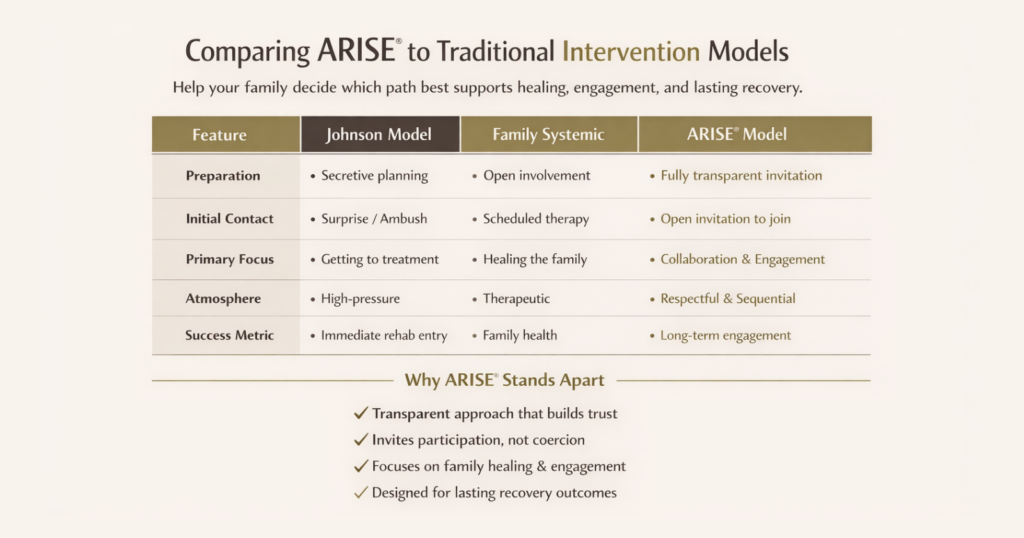
Comparing ARISE® to Traditional Methods
To help you decide which path is best for your family, it is helpful to look at how these models compare side-by-side.
For many families, the ARISE model feels more aligned with their values of honesty and integrity. It avoids the trauma of a surprise confrontation while still providing a structured path toward clinical help. It’s a common misconception that an intervention has to be a “showdown.” In reality, the most effective interventions are often the ones that feel like a warm embrace from a community that refuses to give up.
Why Engagement Matters More Than Coercion
One of the biggest criticisms of older, high-pressure intervention models is the “revolving door” phenomenon. If a person is forced into treatment against their will through intense shame or threats, they might complete the 30 days of rehab just to get people off their back. However, their internal motivation for change remains low.
The ARISE model focuses on “engagement.” Engagement is different than compliance. When an individual is engaged, they understand why they need help and they feel supported in that decision. They aren’t just going through the motions to satisfy a “bottom line” set by their parents or spouse. They are participating in their own rescue. This shift in mindset is often the difference between a temporary period of sobriety and a lifetime of recovery.
Uniting the Family for Long-Term Recovery
Regardless of whether a family utilizes the invitational ARISE model or a different approach, the most critical underlying factor for long-term success is the unification and healing of the family unit. Addiction shatters relationships, and professional recovery services must focus on repairing those bonds. If the family remains in a state of chaos, the individual returning from treatment will be walking back into an environment that triggers a relapse.
For instance, comprehensive consulting services recognize that interventions are just the beginning. Utilizing a holistic framework like The G3 Reclaim Approach, families are guided through a structured pathway to ensure no one is left behind. This approach ensures that while the individual is in treatment, the family is doing their own “rehab” by learning about the biology of addiction, the psychology of enabling, and the art of healthy communication.
The Three Pillars of the G3 Reclaim Approach
- Gather: The first essential step is bringing families together. The process begins by gathering everyone who genuinely cares about the loved one in crisis. The core message here is profound but simple. You are not alone, and neither is your loved one. By uniting as a cohesive front, the family provides an unbreakable network of support. This gathering phase is where the family finds their collective voice.
- Guide: Because every family dynamic is entirely unique, cookie-cutter solutions do not work. This phase is about providing personalized, expert support tailored specifically to your family’s unique situation. Professionals walk side-by-side with the family through the entire continuum of care, from the initial intervention planning all the way through long-term aftercare. This guidance helps the family navigate the “middle ground” of recovery where things often get messy.
- Grow: True recovery extends far beyond just stopping the substance use. It is about where the deep healing happens. This final pillar focuses heavily on healing and rebuilding fractured relationships. It is a dedicated effort to turn past struggles into future strengths, ultimately restoring hope for the family’s future. Growth is a continuous process that requires patience and a commitment to a new way of living.
Addressing the Fear of “Doing it Wrong”
Many families paralyze themselves with the fear that they will say the wrong thing or choose the wrong model, and their loved one will leave forever. This is a valid fear, but it’s important to understand that the “wrong” thing to do is usually to do nothing at all. Addiction is a progressive disease. It does not get better on its own.
The beauty of working with a professional interventionist is that they carry the heavy lifting for you. They are trained to handle the outbursts, the denials, and the emotional manipulation that often comes with active addiction. When you use a model like ARISE®, you aren’t “doing it” to the person. You are doing it with them. This subtle shift in preposition changes the entire energy of the room.

The Role of Aftercare in the Intervention Process
A successful intervention is not just about the day the person leaves for treatment. It is also about what happens six months later. Many traditional models stop their involvement once the person is behind the doors of a rehab center. Modern, relational models understand that the “transition” home is the most dangerous time for a person in early recovery.
A comprehensive intervention plan should include an aftercare strategy. This might involve:
- Regular family check-ins with the interventionist.
- Participation in Al-Anon or other family support groups.
- Structured “re-entry” meetings when the individual returns from treatment.
- Continued individual therapy for all family members.
By treating the intervention as a “sequence” (as the ARISE acronym suggests) rather than an event, the family creates a long-term safety net. This net catches the individual if they stumble and celebrates with them as they succeed.
Taking the Next Step Toward Healing
Living with a loved one’s addiction is a heavy burden, but you don’t have to do this alone. All the fear, doubt, and helplessness you are experiencing are valid, but they do not have to be permanent. The cycles of worry can be broken, and the path to a healthier future is clearer than it has ever been.
By leaning on professional guidance and choosing an intervention model that aligns with your family’s core values, such as the transparent, highly effective ARISE invitational model, you can begin the process of reclaiming your family’s life. With over 75 percent of individuals eventually finding recovery, the odds are in your favor when you have the right team behind you.
If you are ready to take the next step and explore how an intervention can help your family turn its pain into purpose, reach out for professional support today. Remember, the best time to start was yesterday, but the second best time is right now. Your family deserves a future that isn’t defined by the shadow of addiction, and that future begins with a single, brave conversation. It is a journey that require courage, but the destination of a restored family is worth every effort.
Need Immediate Support?
Call us or send a message through our website. A better future can start with one courageous step.
Contact us or call (214) 927-2154 for a confidential consultation with Matt and Hannah Gibson’s team.
Book a Consultation
It’s easy and free!