
When people picture an intervention, they often picture someone addicted to heroin, meth, or prescription pills, an unmistakable, visible kind of use that leaves little room for denial. Alcohol is different, and that difference matters enormously when it comes to planning and executing an intervention. Alcohol is legal. It's normalized. It's available everywhere. And the …

When people picture an intervention, they often picture someone addicted to heroin, meth, or prescription pills, an unmistakable, visible kind of use that leaves little room for denial. Alcohol is different, and that difference matters enormously when it comes to planning and executing an intervention.
Alcohol is legal. It’s normalized. It’s available everywhere. And the social and cultural frameworks around heavy drinking mean that denial, both from the person struggling and from the people around them, runs deeper and more stubbornly than with almost any other substance. Families often wait years longer to intervene on alcohol than they would for any illicit drug, because the story they tell themselves, and that their loved one tells them, is more believable.
At G3 Recovery, we’ve worked on alcohol interventions in cities across the country, from Dallas to Miami to Los Angeles to Washington, D.C., and we’ve seen these dynamics play out in nearly every case. Here’s what makes alcohol intervention distinct, and how we approach it.
The Normalization Problem
With drug addiction, the social context usually works in the family’s favor. No question that using heroin is a problem. There’s no professional culture that celebrates meth use. The substance itself carries enough stigma that when a family expresses serious concern, the person struggling has less room to dismiss it as an overreaction.
Alcohol doesn’t work that way. A person drinking a bottle of wine a night can point to dozens of people in their professional or social circle doing the same thing. The executive who starts every evening with “a couple of scotches” before moving to half a bottle has colleagues who drink just as much. The college-educated professional who drinks daily can find enormous cultural reinforcement for that behavior.
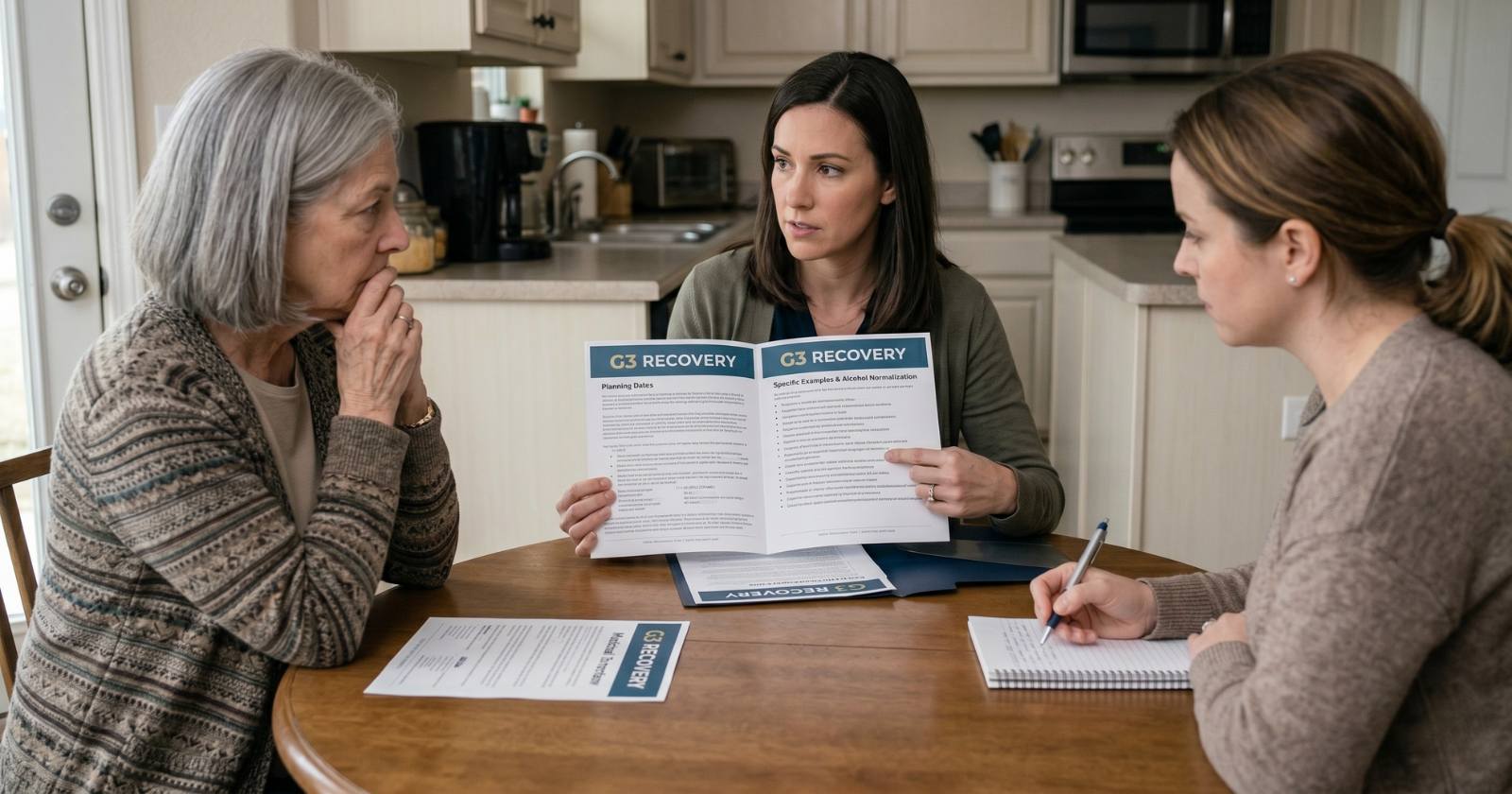
This normalization means the denial structure in alcohol intervention is usually thicker. Families need to come prepared with specific, concrete examples of behavior not generalizations, not comparisons, but specific moments and their consequences. Our pre-intervention coaching helps families build this foundation before they ever sit down with their loved one.
Medical Withdrawal Is a Real Risk
This is the most clinically significant difference between alcohol intervention and drug intervention, and it’s one that every family needs to understand before they act.
Alcohol withdrawal, in a person with significant physical dependence, can be medically dangerous. Unlike most other substances, where withdrawal is agonizing but rarely life-threatening, alcohol withdrawal can produce seizures and delirium tremens (DTs), which carry real mortality risk if not managed medically.
This means two things for intervention planning:
First, we need to assess the level of physical dependence before the intervention. We’re not trying to scare families, most people with alcohol use disorder can manage supervised outpatient detox safely. But some cannot, and we need to know the difference going in.
Second, the placement after the intervention must include medical detox capability. We don’t place someone with significant alcohol dependence in a program that isn’t equipped to manage withdrawal medically. This is a non-negotiable for us, and it’s one of the reasons having an experienced team matters in cities like Philadelphia and Miami markets, where the range of facility quality is enormous.
Functional Alcoholism Is the Most Common Presentation We See
The majority of alcohol interventions we conduct are not for people who have “hit bottom” in the traditional sense. They are for people who are still employed, still maintaining a household, still showing up to most of their obligations, but whose drinking has quietly become the organizing principle of their life.
They don’t drink in the morning (usually). They don’t miss work (mostly). They’re not visibly disheveled. But they drink every evening without exception. They get irritable and anxious when they can’t drink on schedule. They’ve tried to cut back or quit several times, and it hasn’t held. Weekends look different from weeks. Vacations and travel revolve around drinking logistics.
This presentation is extremely common in professional and high-functioning populations, and it’s well-represented in the cities where we work; major metros like Los Angeles, D.C., Dallas, and Miami have large professional populations where this pattern is prevalent.
The intervention challenge with functional alcoholism is that the consequences haven’t been dramatic enough yet for the person to fully acknowledge the problem. Our job is to make the costs visible not through shock or shame, but through carefully prepared, specific, honest communication from the people who love them.
How We Approach the Intervention Itself
Alcohol interventions follow the same evidence-based structure we use for all substances: family preparation, professional facilitation, treatment placement arranged in advance, and transport ready.
But the specific coaching we do with families is calibrated for alcohol’s particular denial patterns:
We prepare families to expect minimizing language. “I can quit anytime I want.” “I only drink wine.” “You drink too.” “My doctor said my labs are fine.” These responses are predictable, and families who haven’t anticipated them get derailed. We make sure no one is caught off guard.
We focus on impact, not diagnosis. We don’t need everyone in the room to agree that their loved one is an alcoholic. We need them to be able to speak clearly and specifically about what they’ve witnessed and how it’s affected them. The emotional truth of those statements carries more weight than any clinical label.
We have the treatment selected and arranged before we walk in. The worst outcome of any intervention is a successful emotional breakthrough followed by a 48-hour delay before treatment. In that window, ambivalence returns, and the window closes. Whether the person is in Florida, Georgia, or somewhere in between, we have placement ready before the conversation starts.
The Long Game: Why Alcohol Recovery Requires Robust Aftercare
Because alcohol is so embedded in social life, recovery requires more than just completing a residential program. It requires building a life structure where sobriety is sustainable where social events, professional situations, and even family gatherings don’t create constant relapse pressure.
We factor this into our placement recommendations. Programs with strong alumni networks, solid outpatient step-down structures, and robust family involvement in aftercare planning produce better long-term outcomes for alcohol use disorder. We know which programs those are in the markets where we operate.
If You Think Alcohol Is the Problem, It Probably Is
Families often second-guess themselves with alcohol because the cultural noise around drinking is so loud. They wonder if they’re overreacting. They compare their loved one’s drinking to friends who drink the same amount and seem fine. They wait for a dramatic event that may never come, and by the time it does, the consequences are much worse than they needed to be.
If you’re reading this, something has already triggered enough concern that you’re looking for answers. Trust that. Reach out and talk to our team. If your loved one is in Dallas, Miami, Los Angeles, Philadelphia, D.C., or anywhere in between, we can help you assess the situation and build a plan, whether the time for intervention is now or still in the evaluation phase.
The fact that it’s “just alcohol” doesn’t make it less serious. In many ways, it makes a structured, professional approach more important.
Book a Consultation
It’s easy and free!