
Minnesota Overdose Deaths Rose in 2025. Stimulants Are Why.
Opioid deaths in Minnesota fell again in 2025. Total overdose deaths still went up, driven by methamphetamine and cocaine. For families, that shift matters, because stimulant use rarely looks like the emergency people have learned to recognize.
What did Minnesota’s 2025 overdose report find?
Minnesota recorded 1,025 drug overdose deaths in 2025, up 3 percent from 994 in 2024, according to preliminary data the Minnesota Department of Health released October 27, 2026. Opioid-involved deaths fell for a third straight year, to 671. Deaths involving methamphetamine and cocaine rose, and they drove the overall increase.
The figures come from the Minnesota Department of Health (MDH) 2025 data update on statewide overdose trends. Opioid-involved deaths have declined from a high of 1,039 in 2022, and fentanyl-involved deaths fell 6 percent last year, from 602 to 564. Health Commissioner Dr. Brooke Cunningham credited prevention, naloxone, treatment, harm reduction and recovery services for that progress, while naming “the growing health impacts” of cocaine and methamphetamine as the next problem to solve.
Why did deaths rise when opioid deaths fell?
Stimulants. MDH reports that deaths involving psychostimulants, mainly methamphetamine, rose 11 percent in 2025, and cocaine-involved deaths rose 6 percent. Hospital visits for nonfatal stimulant overdoses climbed 11 percent, from 1,047 to 1,162, with methamphetamine visits up 17 percent.
The bigger story is that few overdoses involve only one drug. Mixed drug use was present in 70 percent of Minnesota overdose deaths since 2020, and deaths involving both an opioid and a stimulant more than doubled between 2019 and 2025. In the state’s toxicology sampling, nearly two out of three samples that tested positive for opioids also contained amphetamines.
The increase is not limited to one part of the state. Hospitals in the Twin Cities metro treated 882 stimulant overdoses in 2025, up 13 percent. Greater Minnesota treated 280, up 6 percent, and cocaine overdoses treated outside the metro rose 19 percent, a pattern Medical Daily also highlighted.
Families have learned to take opioids seriously, and that is real progress. Meth and cocaine can feel slower and easier to explain away. A person is up for three days, loses weight, gets suspicious, and everyone calls it stress. That is often how a family loses a year.
Does naloxone work on a meth or cocaine overdose?
Naloxone reverses opioid overdoses. It does not reverse the effects of methamphetamine or cocaine, and there is no equivalent antidote for a stimulant overdose. That does not make naloxone less important. Because fentanyl is so often mixed into the supply, MDH advises that naloxone should still be considered and given when an overdose may involve mixed drugs.
A stimulant overdose is a medical emergency in its own right. According to the National Institute on Drug Abuse, methamphetamine overdose can cause stroke, heart attack or organ failure. Signs that call for 911 include chest pain, a very high body temperature, seizures, severe confusion or agitation, and trouble breathing. If you are unsure, call. Our guide to when it is an emergency, and when to call 988 sets out the difference.
According to MDH, Minnesota’s Good Samaritan law offers protection from arrest or prosecution for certain drug-related activity when someone calls 911 for an overdose. Naloxone is sold over the counter, and the MDH naloxone page explains where else to find it.
What does “14 survivors for every death” mean for a family?
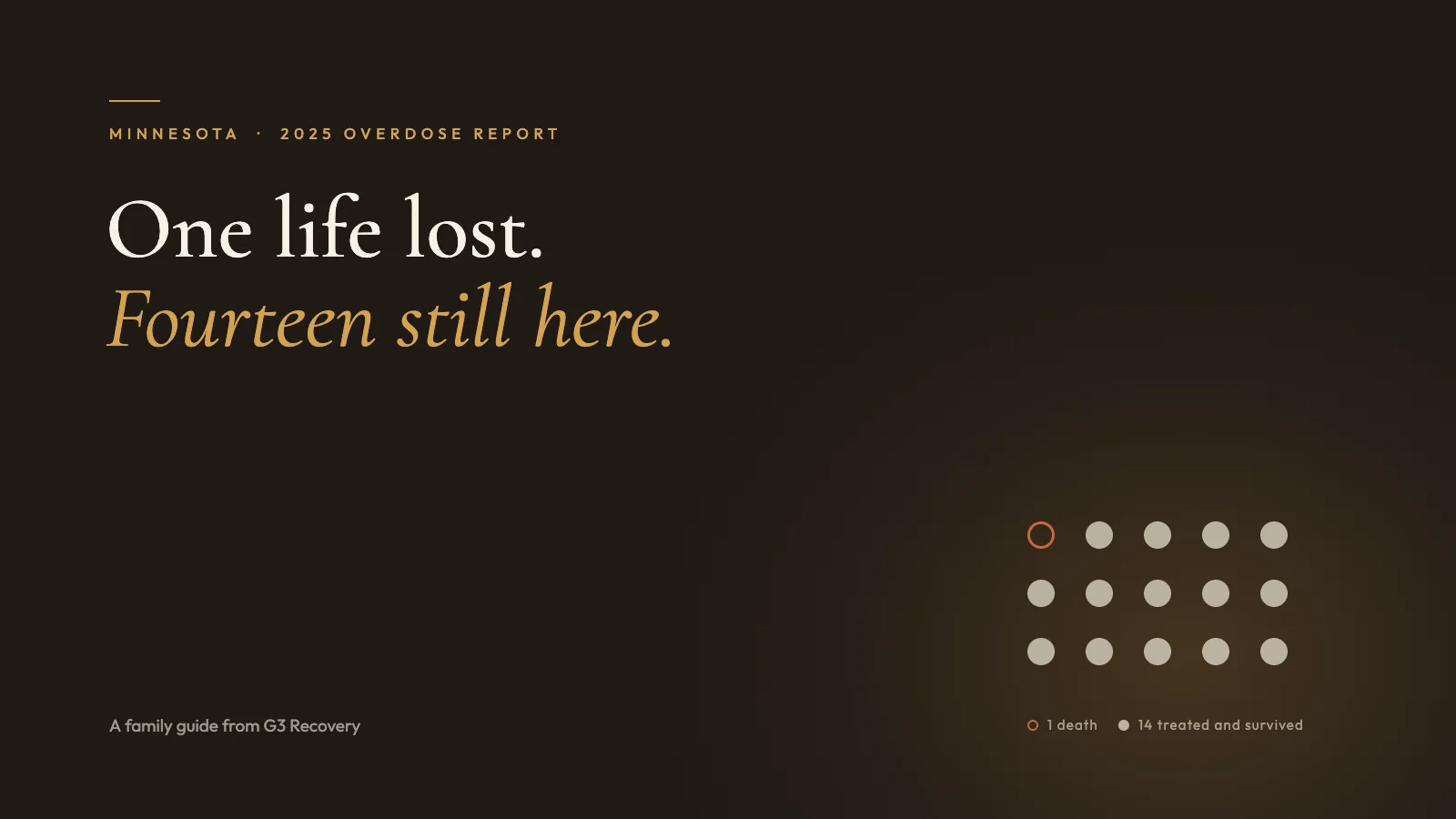
It means most overdoses are survived, and each one is a warning that arrived in time. MDH found that for every Minnesotan who died of an overdose in 2025, 14 were treated in a hospital and survived. Those 14 people went home to someone. What that household does next matters.
Medical care always comes first. Once your person is safe, the days after a hospital visit are a window for something more deliberate.
- FirstGet naloxone into the house and make sure every adult knows where it is kept, even if the drug you know about is meth or cocaine.
- SecondWrite down what you have seen, with dates. Stimulant use is easy to argue about in general and much harder to argue about in specifics.
- ThirdAgree as a family on one message. Different relatives saying different things is the easiest response for anyone to dismiss.
- FourthIdentify a treatment option that fits the clinical need, including any mental health symptoms, before you ask anyone to say yes to it.
A hospital visit that ends in a discharge is not the end of the emergency. It is often the most honest week a family will get, and the best time to stop debating whether there is a problem and start deciding what to do about it.
What does stimulant use look like at home?
Often it looks like something else. Families describe a person who stops sleeping for long stretches, then crashes. Weight drops. Money goes missing. Moods swing between intense energy and irritability, and some people become suspicious or paranoid. Because the person may still be working and functioning, the pattern can go unnamed for a long time.
None of these signs proves drug use on its own, and a family should never try to diagnose. They are reasons to look closer and to talk to a professional. Our family guide to meth and cocaine explains what each tends to look like, and our guide to fentanyl and opioids covers why a mixed supply raises the stakes.
What can a Minnesota family do when someone still says no?
This is where a professional intervention fits.
Most families who reach us have already tried talking. The talking usually happened one relative at a time, in the middle of an argument, with no treatment option ready to accept. An intervention changes that format: the family prepares together, speaks with one voice, and offers a specific bed that has already been arranged.
G3 Recovery Interventions and Consulting, based in Austin, Texas, works with families across Minnesota, from Minneapolis and St. Paul to Duluth, Rochester and the towns between, and travels to you. Read how we work as a professional interventionist in Minnesota. Stimulant use and mental health symptoms often show up together, and our guide to mental health intervention in Minnesota covers what the law allows and where it stops.
Families do not need perfect words. They need to agree on one message, have a treatment option ready, and decide who makes the call. We can prepare the rest together.
Because G3 accepts no referral fees, our treatment navigation is matched to the clinical need and your budget, in Minnesota or out of state if that is the better fit. When the answer is yes, sober transport gets your person to the door. None of this guarantees an outcome. It gives a yes somewhere to go.