
Missouri Overdose Deaths Fell Again. What That Means for Your Family.
Missouri’s overdose deaths dropped for a third straight year in 2025. That is real progress, and it deserves to be said plainly. It also changes very little for a family whose person is still using today.
What did Missouri’s 2025 overdose report find?
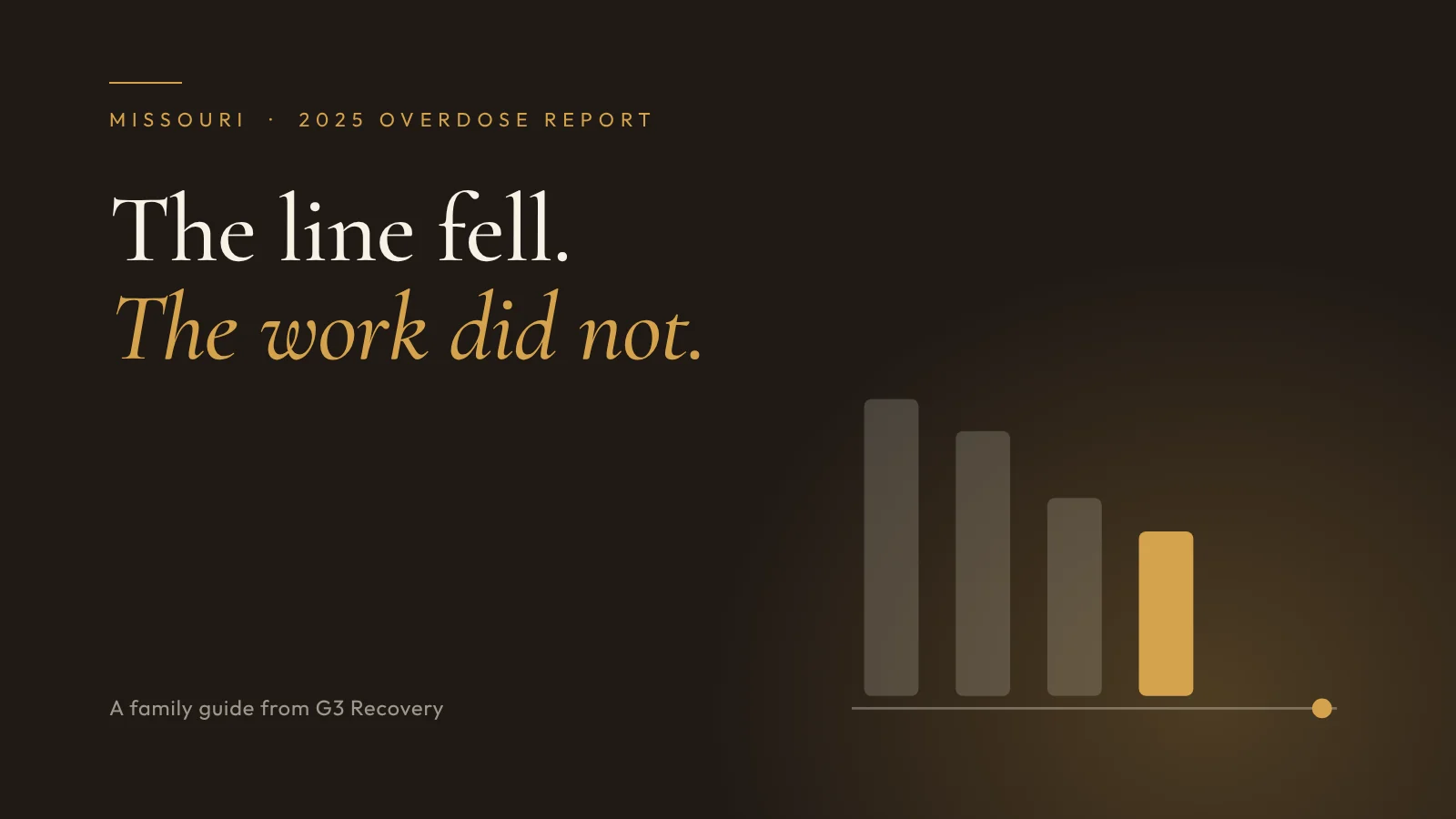
Missouri recorded 1,205 drug overdose deaths in 2025, according to a University of Missouri-St. Louis report released October 29, 2026. It is the third straight yearly decline and the lowest count since at least 2016, down from a 2022 peak of 2,180. Fentanyl still drives the crisis, and non-fatal overdoses remain common.
The report comes from the University of Missouri-St. Louis Addiction Science Team, working from Missouri Department of Health and Senior Services (DHSS) data. The year before, the same team counted 1,450 deaths in 2024 and 1,948 in 2023. For the first time in nearly a decade, Missouri’s overdose death rate now sits below the national rate.
Does a falling statewide number lower your family’s risk?
Not on its own. A statewide count describes a population, and the decline is spread unevenly across Missouri.
Your family is not a population. The St. Louis region still recorded the most deaths in the state, 542, even after a 7 percent drop, and the Kansas City area followed with 314.
The researchers were careful about what the numbers can and cannot say. Fewer deaths does not mean fewer overdoses. Dr. Rachel Winograd, who leads the UMSL team, pointed to “a ton of non-fatal overdoses” still happening across the state, and to steady demand for naloxone. Part of the drop may come from a less potent drug supply in recent years, which is a hope, not a guarantee.
That is the honest read for a family. The odds across Missouri have improved. The risk inside one house, with one person, one supply and one bad night, has not been averaged away.
When the statewide number goes down, families sometimes exhale and wait. I understand that. But the person you love is not an average, and the right time to plan is while things are quiet enough to plan.
Why do the days after a non-fatal overdose matter so much?
If someone you love has already survived an overdose, that event is the clearest signal a family will get. Public health researchers have found a link between an emergency room visit for an opioid overdose and a higher risk of a later fatal one. The hospital stabilizes the body. What happens in the days after is largely up to the people around them.
Medical care always comes first. If someone is unresponsive, breathing slowly or not at all, call 911, give naloxone if you have it, and stay with them. Our guide to when it is an emergency, and when to call 988 sets out the difference. Once the person is safe, the window opens for something more deliberate.
- FirstGet naloxone into the house and make sure every adult knows where it is kept.
- SecondAgree as a family on one message. Mixed signals from different relatives are the easiest thing to argue with.
- ThirdIdentify a treatment option that fits the clinical need before you ask anyone to say yes to it.
- FourthDecide who will make the call, and when. Plans that belong to everyone tend to belong to no one.
A non-fatal overdose is frightening, and it is also a door. The days after are often when a person is willing to hear that their family is ready to help, and we want families to call while that door is open.
How can a Missouri family get naloxone?
At a Missouri pharmacy, without a prescription. Under the statewide naloxone standing order issued by the Department of Health and Senior Services, effective June 3, 2026, Missouri pharmacists can dispense naloxone to family members, friends and others in a position to help someone at risk, when they ask for it. If cost is the barrier, the order points pharmacists to GetMissouriNaloxone.com.
Naloxone is also sold over the counter, and according to KSMU’s reporting on the standing order, Medicaid and many private plans cover it at little or no cost. Keep it somewhere obvious, not locked away, and tell visitors where it is.
Keep naloxone in the house and tell everyone where it is. That is not giving up on someone. It is making sure there is a tomorrow to keep working on.
Is the drug supply in Missouri still dangerous?
Yes. The supply remains mixed, and a person rarely knows exactly what they are taking.
Fentanyl has driven Missouri’s overdose deaths for years, and stimulants such as methamphetamine and cocaine are a common factor too. KSMU reports that nitazenes, a newer class of synthetic opioids, have turned up in Missouri wastewater. A person who believes they only use one drug may be exposed to several.
For families, that means two things. Naloxone matters even when opioids are not the drug of choice, and treatment needs to be matched to the whole picture, not just the substance the family knows about. Our family guides to fentanyl and opioids and to meth and cocaine explain what each looks like at home.
What can a family do when someone still says no?
This is where a professional intervention fits.
Most Missouri families who reach us have already tried talking. The talking usually happened one relative at a time, late in an argument, with no treatment option ready to accept. An intervention changes that format: the family prepares together, speaks with one voice, and offers a specific bed that has already been arranged.
G3 Recovery Interventions and Consulting, based in Austin, Texas, works with families across Missouri, from Kansas City to St. Louis and the towns between, and travels to you. Read how we work as a professional interventionist in Missouri. If alcohol is part of the picture, see our page on alcohol intervention for St. Louis families. If a mental health crisis is mixed in with the drug use, our guide to mental health intervention in Missouri covers what the law allows and where it stops.
Because G3 accepts no referral fees, our treatment navigation is matched to the clinical need and your budget, in Missouri or out of state if that is genuinely better. When the answer is yes, sober transport gets your person to the door. None of this guarantees an outcome. It gives a yes somewhere to go.