TLDR: The Marchman Act DemystifiedThe Florida Marchman Act is a powerful civil tool designed to save lives when a loved one is blinded by substance abuse and refuses help. It is not a criminal proceeding, does not result in a "record," and is often the final necessary step for chronic relapsers. Success requires navigating "Marchman-friendly" …


TLDR: The Marchman Act Demystified
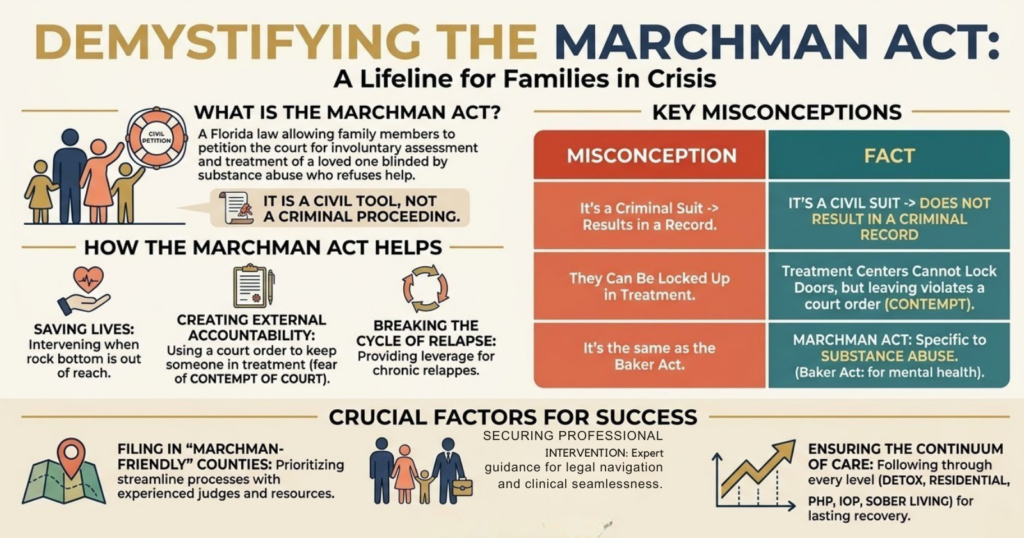
The Florida Marchman Act is a powerful civil tool designed to save lives when a loved one is blinded by substance abuse and refuses help. It is not a criminal proceeding, does not result in a “record,” and is often the final necessary step for chronic relapsers. Success requires navigating “Marchman-friendly” counties and securing professional intervention to ensure the court-ordered treatment plan is followed through every level of care.
Navigating the Florida Marchman Act: A Lifeline for Families in Crisis
If you’re reading this, chances are you’ve reached your breaking point. You’ve watched someone you love fade behind the grip of addiction, and every “rock bottom” seems to open another trap door leading further down. The fear you feel is massive, but the process shouldn’t be. At G3 Recovery Interventions and Consulting, we specialize in Florida Intervention Services because we know that sometimes, “tough love” needs the weight of the law behind it.
What Exactly is the Marchman Act?
The Hal S. Marchman Alcohol and Other Drug Services Act of 1993, more commonly known as the Marchman Act, is a unique Florida statute. It provides a legal pathway for family members to petition the court for the involuntary assessment, stabilization, and treatment of a person who has lost the power of self-control regarding substance abuse. People often think it’s a “big scary thing” that involves handcuffs and jail cells, but it’s actually a civil procedure focused entirely on healthcare. Many families find that once they understand the law, their anxiety level actually drops quite a bit.
Clearing Up the Criminal Misconception
One of the most frequent questions we receive is: “Is the Marchman Act a criminal suit against my loved one?” The answer is a resounding no. This is a civil suit, and it is filed in civil court, not criminal court. Because of this, the process does not result in a criminal record that would show up on a standard background check for employment or housing. You aren’t “reporting” them for a crime; you are petitioning for their right to live. It is important to remember that the goal is recovery, and the law is there to protect the individual from their own self-destructive impulses.
2026 Update: Privacy and the Marchman Act
A common fear for families is that filing a petition will create a public “paper trail” that could follow their loved one forever. As of July 1, 2026, Florida law (HB 447) has significantly strengthened the privacy of these proceedings.
Closed Hearings: All Marchman Act hearings are now confidential and closed to the public by default.
Sealed Records: Petitions, clinical assessments, and court orders are exempt from public record. This ensures that a “medical crisis” stays a medical matter, protecting your loved one’s future employment and reputation from public search engines or background checks.
Marchman Act vs. Baker Act
Families often confuse these two, but using the wrong one can lead to a “revolving door” experience.
| Feature | Baker Act | Marchman Act |
| Primary Focus | Acute Mental Health Crisis | Substance Abuse & Addiction |
| Typical Stay | Up to 72 Hours | 5-Day Assessment + Up to 60/90 Days Treatment |
| The “Gap” | Often discharges once the drug-induced psychosis fades. | Designed to keep them in a bed until the “fog” of addiction lifts. |
| Goal | Immediate safety & stabilization. | Long-term clinical recovery and life skills. |
Can a Treatment Center Hold Them Against Their Will?
This is where the nuances of the law get a bit tricky. While the court mandates an individual to treatment, a facility is not a prison. Most centers cannot physically lock someone in a room or bar the doors to keep them from leaving. However, there is a major “but” here: if the individual is under a court order and decides to walk out, they are in contempt of court. In these cases, the authorities are contacted, and the individual can be picked up and led back into treatment or, in some cases, face time in a detention center for violating the judge’s order. This leverage is often what keeps a chronic relapser in their seat during the hardest days of detox.
Understanding the Petitioning Process: Step by Step
Filing a petition is a brave act of love, but it requires specific documentation to be successful. In Florida, the petitioner must demonstrate that the individual has lost the power of self-control with respect to substance use. This isn’t just about “using drugs”; it’s about the inability to make rational decisions for one’s own safety. The court looks for evidence that the person has either inflicted, or is likely to inflict, physical harm on themselves or others. Alternatively, the court may act if the person’s judgment is so impaired that they don’t realize they need help.
The Assessment Phase
Once the petition is filed, the court may issue an order for an involuntary assessment. This typically involves a 3-to-5-day stay at a licensed facility where medical and clinical professionals evaluate the individual’s level of addiction. During this time, the “fog” of active use begins to lift, and a formal recommendation for long-term treatment is made to the court. It’s often the first time in years that the family has felt a sense of peace, knowing their loved one is in a safe, monitored environment.
The Treatment Order
Following the assessment, a second hearing is held to determine the length and type of treatment required. This is where G3 Recovery’s Professional Guidance becomes invaluable. We help families present a comprehensive treatment plan to the judge, ensuring that the facility chosen is capable of meeting the specific needs of the individual. The court can then order the person into treatment for up to 60 or 90 days initially.
The Evidence Checklist
If you are preparing to file, the judge needs more than just a feeling—they need “clear and convincing evidence.” Gather these items before heading to the Clerk of Court:
The 90-Day Timeline: Document specific dates of overdoses, ER visits, or incidents where they endangered themselves or others (e.g., driving under the influence with children present).
The “Three-Person” Rule: While one family member can file, having three adults with personal knowledge of the addiction sign the petition carries immense weight and makes the case significantly stronger.
Financial Readiness: Have your insurance information or proof of funds for a private facility ready. If a judge orders treatment, they will want to know exactly where the “bed” is and who is paying for it.
Why “Marchman-Friendly” Counties Matter
Florida is a large state with 67 different counties, and unfortunately, the way the Marchman Act is handled can vary significantly from one jurisdiction to another. Some counties have streamlined processes with dedicated judges and “drug courts” that are intimately familiar with the nuances of addiction. These Marchman-friendly counties prioritize these cases, often moving from petition to assessment in a matter of days. In other counties, the process can be bogged down by paperwork or a lack of available beds in state-funded facilities.
Identifying the Right Jurisdiction
When you are in a crisis, you don’t have time to research the local court rules of every county in Florida. At G3 Recovery, we have spent years building relationships and understanding the landscape of Florida-specific recovery resources. We help families determine the best place to file based on where the individual is located and where the most favorable legal outcome is likely. This strategic approach minimizes the “red tape” and gets your loved one into a bed faster.
The Role of the Judge
The judge plays a pivotal role in the success of a Marchman Act case. A judge who understands addiction as a brain disease will be more likely to enforce the treatment order strictly. They understand that the individual’s resistance is a symptom of the disease, not a personal affront to the court. Having a “Marchman-friendly” judge means having a partner in the recovery process who will hold the individual accountable to their clinical goals.
The Chronic Relapse Cycle: Breaking the Pattern
For many families, the Marchman Act isn’t the first attempt at help; it’s the tenth or twentieth. Chronic relapse is a heartbreaking reality of the opioid and stimulant crises. When an individual repeatedly goes to voluntary treatment only to leave against medical advice (AMA) after three days, the family feels helpless. The Marchman Act is specifically designed for these “frequent flyers” of the system.
Families struggling with severe addiction often need specialized support depending on the substance involved. Our team regularly helps families coordinate drug intervention services in Jacksonville, including targeted support for cocaine addiction interventions, methamphetamine interventions, heroin addiction interventions, and fentanyl intervention services for families facing the growing opioid crisis.
Creating Lasting Accountability
The primary benefit of a court order for a chronic relapser is the external accountability. When the brain’s internal reward system is broken, the person cannot rely on their own “willpower” to stay in treatment. The court order provides a concrete reason to stay: the fear of legal consequences. While we want the individual to eventually find internal motivation, the Marchman Act provides the “guardrails” that keep them safe until that motivation can be cultivated.
Following the Continuum of Care
Recovery isn’t a 28-day event; it’s a lifelong process. One of the greatest strengths of the Marchman Act is that the order can follow the individual through each level of care. This includes:
- Detox: Medical stabilization.
- Residential: Intensive clinical work.
- Partial Hospitalization (PHP): Transitioning back to the community while still in full-time treatment.
- Intensive Outpatient (IOP): Part-time treatment while living in a sober environment.
- Sober Living: The final step toward full independence.
By extending the order for up to a year, the court ensures there are no “gaps” in the recovery process where a relapse is most likely to occur. In many situations, families also need help safely transporting a loved one to treatment. Our Florida sober transport services ensure individuals arrive safely and discreetly at detox or treatment facilities so the recovery process can begin without unnecessary delays.
The Financial and Emotional Impact of Proactive Intervention
While the legal process involves some upfront costs, families must consider the alternative. Active addiction is an incredibly expensive endeavor, both financially and emotionally. Between the cost of the substances themselves, the loss of employment, and the inevitable legal fees from DUI or possession charges, the “cost” of doing nothing is astronomical. Working with an experienced Florida intervention specialist can help families take action before addiction leads to more serious legal or medical consequences.
Avoiding Future Legal Complications
By enacting a civil intervention through the Marchman Act, you are often preventing a future criminal case. Many of the individuals we help would have eventually ended up in the criminal justice system due to their behaviors while using. The Marchman Act allows the family to take control of the narrative. Instead of waiting for a police officer to make an arrest, the family initiates a process focused on health and restoration. This proactive stance can save thousands of dollars in future criminal defense fees and, more importantly, save the individual’s future reputation.
Emotional Relief for the Family
The “G3” in our name stands for a commitment to comprehensive care, and that includes the family. When a loved one is in the throes of addiction, the family lives in a state of “anticipatory grief.” You are constantly waiting for the “bad phone call.” The Marchman Act transfers the burden of “policing” the loved one from the family to the court system. This allows the family to return to their roles as parents, siblings, and spouses, rather than acting as amateur detectives or jailers.
Common Misconceptions and FAQs
Is the Marchman Act the same as the Baker Act?
No. The Baker Act is for mental health crises where the person is a danger to themselves or others due to a mental illness. The Marchman Act is specifically for substance abuse. While there is often a “dual diagnosis” involved, the Marchman Act is the correct legal tool for addressing the addiction component.
Can I file the petition myself?
Technically, yes, but it is highly discouraged. The paperwork is complex, and if you miss a deadline or fail to provide the correct evidence, the case can be dismissed. Furthermore, having a professional interventionist from G3 Recovery handle the process ensures that the clinical side of the transition is seamless. We handle the logistics so you can focus on healing.
What happens if they still refuse to go?
If a judge signs an order for assessment or treatment and the individual refuses to comply, the judge can issue an “Order to Pick Up.” This authorizes law enforcement to find the individual and transport them to the designated facility. It is a firm but necessary step to ensure the individual’s safety.
The “Voluntary Conversion” Bridge
One of the most successful outcomes of a Marchman Act is when the individual decides to stay on their own. This is called Voluntary Conversion.
How it works: After the initial 5-day assessment, many individuals “wake up” and realize they need help. They can sign voluntary admission paperwork. At G3 Recovery, we encourage this because it empowers the individual. However, the court order usually remains “stayed” (on pause). If they try to leave prematurely, the court order “reactivates,” providing the necessary safety net to keep them in care.
A Path Forward
For families already facing severe addiction, structured services such as drug intervention programs in Jacksonville can help initiate treatment before the situation escalates further. The Florida Marchman Act is not an act of aggression; it is an act of profound compassion. It is the recognition that addiction is a disease that strips a person of their agency, and that the law can serve as a protective shield while they regain their footing. At G3 Recovery Interventions and Consulting, we have walked this path many times. We know the fear, the exhaustion, and the glimmer of hope that remains.
If you are ready to take the next step and explore whether the Marchman Act is the right choice for your family, we are here to guide you. You don’t have to navigate the Florida legal system alone.
Need Immediate Support?
Call us or send a message through our website. A better future can start with one courageous step.
Contact us or call (214) 927-2154 for a confidential consultation with Matt and Hannah Gibson’s team.
Book a Consultation
It’s easy and free!