
Tennessee Overdose Deaths Have Fallen by Half. Naloxone, the 911 Law and a Plan for Nashville and Memphis.
Tennessee is losing about half as many people to overdose as it was three years ago, according to provisional federal data. The decline is real. It has not made any one family safe: in July, Nashville police answered six fatal overdoses in 24 hours. Here is where to get free naloxone in both cities, what Tennessee’s 911 immunity law covers, and what to do this week.

How much have Tennessee overdose deaths fallen?
Tennessee overdose deaths have fallen by about half in three years. CDC provisional data estimate 1,969 deaths in the 12 months ending May 2026, down from 3,937 for the year ending May 2023 and 2,337 a year earlier. Nashville still sees deadly clusters, which is why naloxone and a family plan matter.
The figures are the provisional drug overdose death counts that the Centers for Disease Control and Prevention (CDC) publishes monthly for every state. Each covers a rolling 12 months, adjusted for delayed reporting.
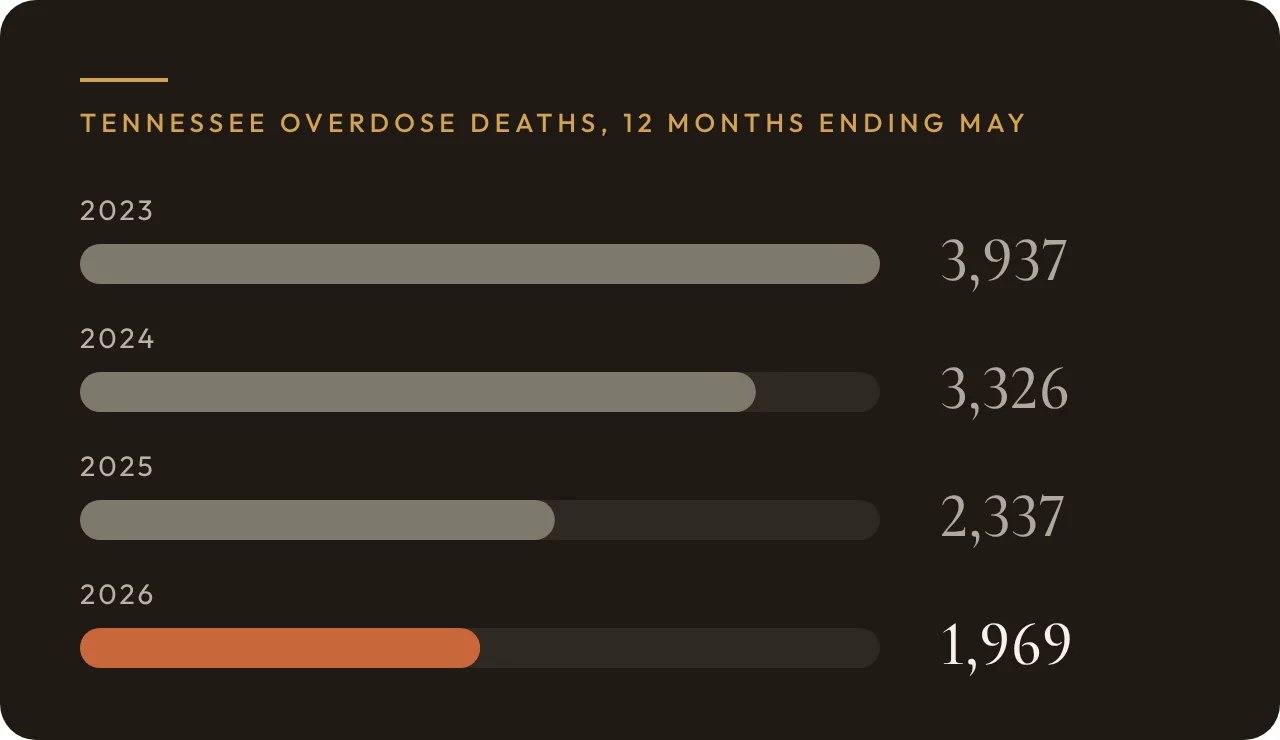
Read the chart as a direction, not a finish line. At the latest estimate, Tennessee still lost 1,969 people in a year, more than five every day.
Is Nashville seeing the same decline?
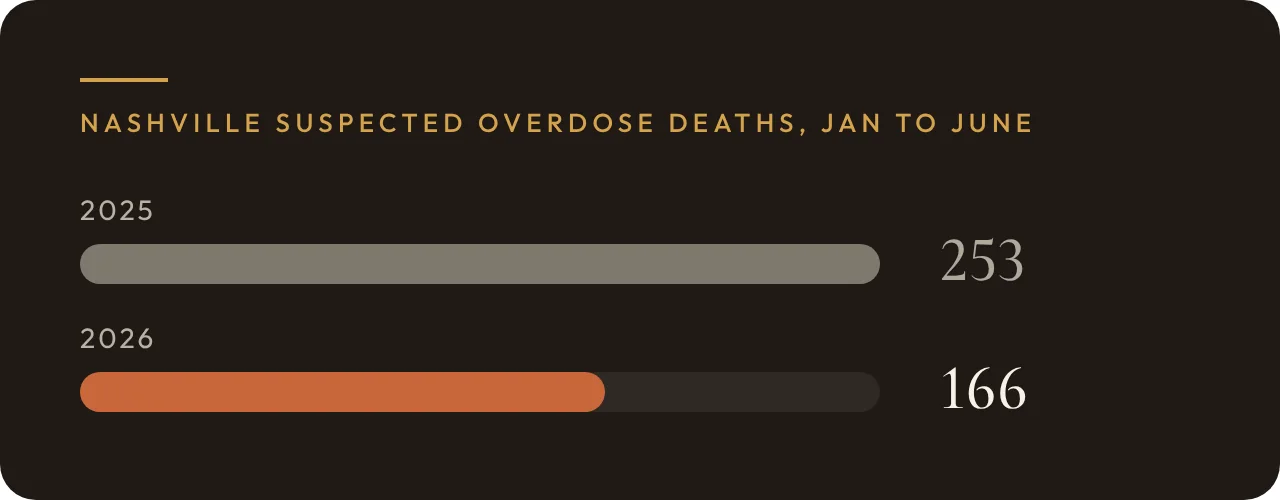
Yes, and the city’s own numbers show it. Axios Nashville reported in April that suspected overdose deaths fell from 530 in 2024 to 428 in 2025, with deaths reaching their lowest point in a decade by the end of the year. Health officials reported 68 suspected overdoses in the last quarter of 2025, the lowest quarterly count since spring 2016. In July, NewsChannel 5 reported Metro Public Health Department figures of 166 suspected fatal overdoses in the first six months of 2026, compared with 253 in the same months of 2025.
Even in a better year, the city can lose several people in a day. On July 14 and 15, the Metro Nashville Police Department responded to six fatal overdoses in 24 hours, WSMV reported. Those who died were 20 to 66 years old, in different parts of the city, and different drugs were involved. Police warned residents never to assume they know what is in street drugs, and on July 15 more than 300 overdose reversal kits went out to affected neighborhoods.
A falling number is real progress, and the people who did that work deserve the credit. But no family I have sat with has been comforted by a statewide average. The question in the room is always smaller and harder: what do we do about this one person, this month?
Who is most at risk in Tennessee now?
Mostly adults in the middle of their lives, using a supply that mixes drugs. The Tennessee Department of Health’s most detailed look comes from its State Unintentional Drug Overdose Reporting System (SUDORS) report, published in June 2025 and covering deaths through 2023. Its findings for 2023:
- Fentanyl was the most common substance. It appeared in 76 percent of overdose deaths, and stimulants appeared in 66 percent.
- Midlife carried the highest rate. The age-specific death rate was highest among Tennesseans 35 to 44.
- Most people had no known bystander. A bystander was documented at the scene in 30 percent of deaths.
- Many had been here before. About one in five had been treated in a hospital for a nonfatal overdose in the year before death, and 68 percent had a documented history of substance use disorder.
Those numbers describe someone many families will recognize: a spouse, a sibling or a grown child in the middle of life, sometimes using more than one drug, and too often alone when it matters most. Our family guides to fentanyl and opioids and to meth and cocaine explain why a mixed supply raises the stakes, and why an adult who says they only use one thing may not know what they took.
When the person is forty, with a job and children and a mortgage, families tend to wait longer. They tell themselves an adult gets to make adult choices. That is true. It is also why the people who love them owe them a plan that treats them as an adult, not another lecture.
Where can Nashville and Memphis families get naloxone?
Naloxone, sold as Narcan, is an emergency medicine that reverses an opioid overdose, including fentanyl. Because fentanyl turns up in other drugs, keep it at home even when the drug you know about is not an opioid.
- Nashville, Metro Health. NewsChannel 5 reports that Metro Public Health distributes Narcan every day through its preventive health clinics, and that residents can also get it at no cost from the pharmacy at the Lentz Public Health Center and at outreach events across the city.
- Nashville, ONEboxes. Metro police told WSMV that 428 locations countywide have ONEboxes, each holding two doses of Narcan, with about 75 more being installed.
- Memphis, by mail. The Shelby County Health Department’s free 901 Care Kits include naloxone, fentanyl test strips and HIV tests, and arrive at your door in an unmarked envelope, FOX13 reported in September. For urgent needs, the department runs a naloxone vending machine in Hickory Hill.
- Any pharmacy. Naloxone nasal spray has been sold without a prescription since the FDA approved it for over-the-counter use in March 2023.
Bruce Randolph of the Shelby County Health Department put it simply to FOX13: “Everyone really should have Naloxone in their home in their first aid kit.” If you think someone is overdosing, call 911, give naloxone and stay with them. If you are unsure whether a situation is an emergency, our guide to when to call 911 and when to call 988 lays out the difference.
Does Tennessee protect people who call 911 for an overdose?
Yes, with limits worth knowing before you need them. Under Tennessee Code Annotated section 63-1-156(b), as amended by Public Chapter 41 of 2023, immunity from being arrested, charged or prosecuted applies to the person experiencing a drug overdose on that person’s first such overdose. For later overdoses, it may be applied at the discretion of the responding law enforcement officer or the district attorney general’s office, as the 2023 legislative summary from the Tennessee Department of Mental Health and Substance Abuse Services (TDMHSAS) also describes.
The department’s naloxone law page describes who and what the protection covers under the Addiction Treatment Act: both the person who in good faith seeks medical help and the person experiencing the overdose are protected from arrest, charge or prosecution for simple possession and casual exchange, or possession of drug paraphernalia, when the evidence was found because help was sought. The same page describes civil immunity for a person who gives naloxone to someone they reasonably believe is overdosing on an opioid. This is general information, not legal advice. Laws change, so confirm current terms with a Tennessee attorney.
The morning after a close call is not the time for a speech. It is the time to say one true thing: we were scared, we love you, and this family is getting help. Then find someone who can help you plan what comes next.
What should a Tennessee family do this week?
Treat the good news as room to act, not a reason to wait.
- FirstPut naloxone in the house and the car, and make sure every adult knows where it is and how to use it.
- SecondAgree as a family that anyone who finds a person unresponsive calls 911 first, without debate.
- ThirdWrite down what you have seen, with dates. A clear record helps any professional you call and keeps the family telling one story.
- FourthLine up a treatment option that fits the clinical need, including any mental health symptoms, before anyone asks your person to say yes.
If your loved one keeps refusing help, a planned family intervention asks for that yes with preparation behind it, and our guide to talking to someone in denial covers the conversations that come before one.

G3 Recovery Interventions and Consulting is based in Austin, Texas, and travels to families across Tennessee, from Memphis to Knoxville and Chattanooga. Read how we work as a professional interventionist in Tennessee, or see our pages on drug intervention for Nashville families and alcohol intervention in Memphis. When a psychiatric crisis is part of the picture, our guide to mental health intervention in Tennessee explains the options under state law. Because G3 accepts no referral fees, our treatment navigation is matched to the clinical need and your budget, in Tennessee or out of state, and sober transport gets your person to the door once they agree.