
Virginia Overdose Deaths Have Nearly Stopped Falling. What Richmond and Northern Virginia Families Can Do.
For two years, Virginia’s overdose numbers fell fast. The state medical examiner’s newest report shows the first half of 2026 barely moved. A plateau is far better than the peak, but it changes what a careful family in Richmond, Fairfax or anywhere between should assume.

What does Virginia’s newest overdose report show?
Virginia’s Office of the Chief Medical Examiner counted 684 preliminary overdose deaths in the first half of 2026, against 709 in the same months of 2025, a drop of about 3.5 percent. After two years of steep declines, the office forecasts 1,370 Virginia overdose deaths for 2026, close to the preliminary 1,400 recorded in 2025.
The numbers come from the Fatal Drug Overdose Quarterly Report for the second quarter of 2026, which the Office of the Chief Medical Examiner (OCME), part of the Virginia Department of Health (VDH), published in October. The first quarter of 2026 came in at 339 deaths, three more than the first quarter of 2025. The second quarter came in at 345, down from 373.
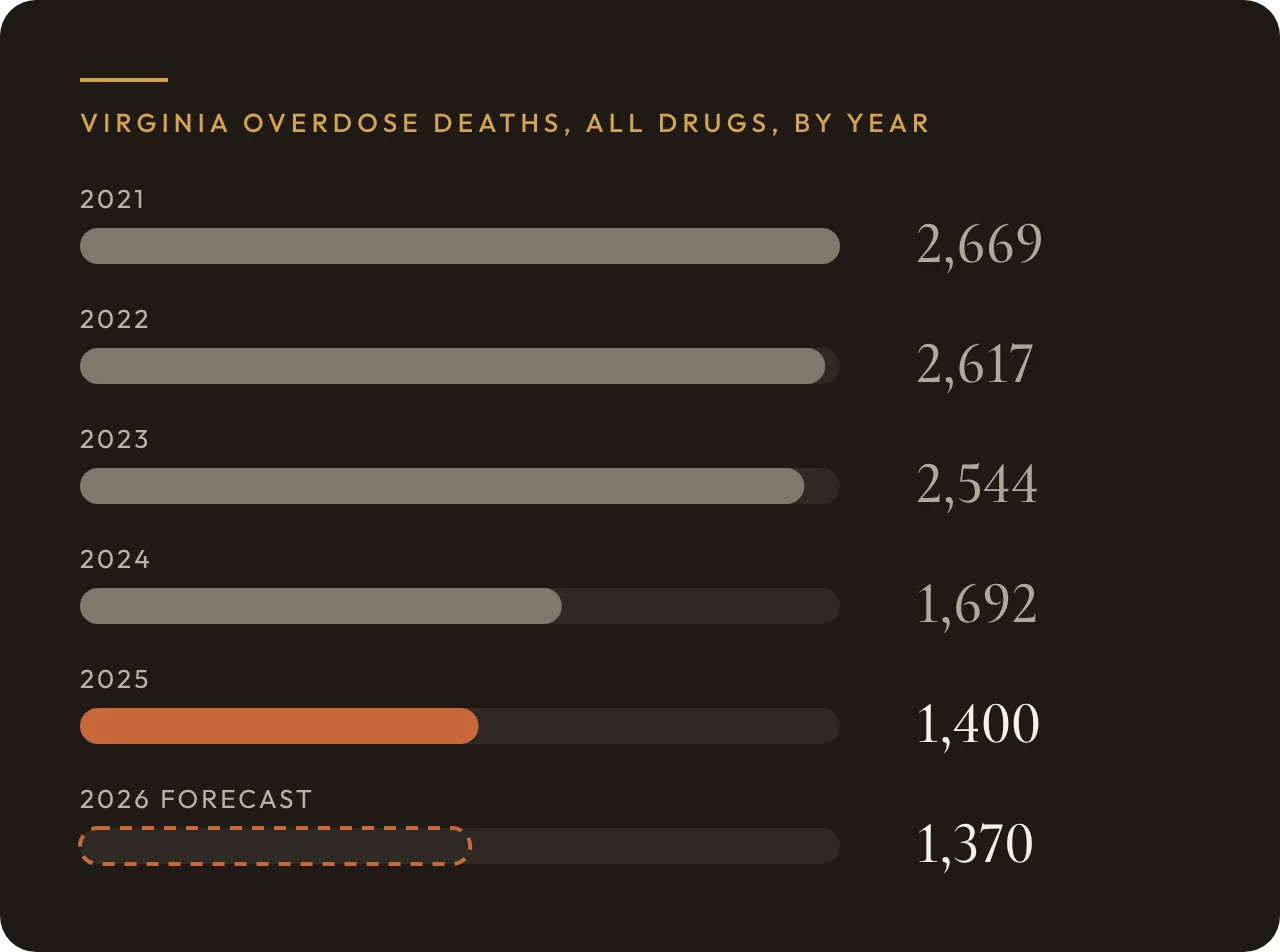
The office calls these counts preliminary and most likely slightly under reported, so expect small revisions. The shape of the line is plain all the same.
Where is the decline stalling?
Not in fentanyl deaths, which are still falling, but in deaths that do not involve fentanyl at all.
The OCME report counts fentanyl deaths separately, quarter by quarter. Subtract them from the all-drug total, as we did here, and a pattern appears that the headline hides. In the first half of 2024, Virginia recorded 673 deaths involving fentanyl and 277 without it. By the first half of 2026, fentanyl deaths had fallen to 344, while deaths without fentanyl had climbed to 340. The two are nearly even.
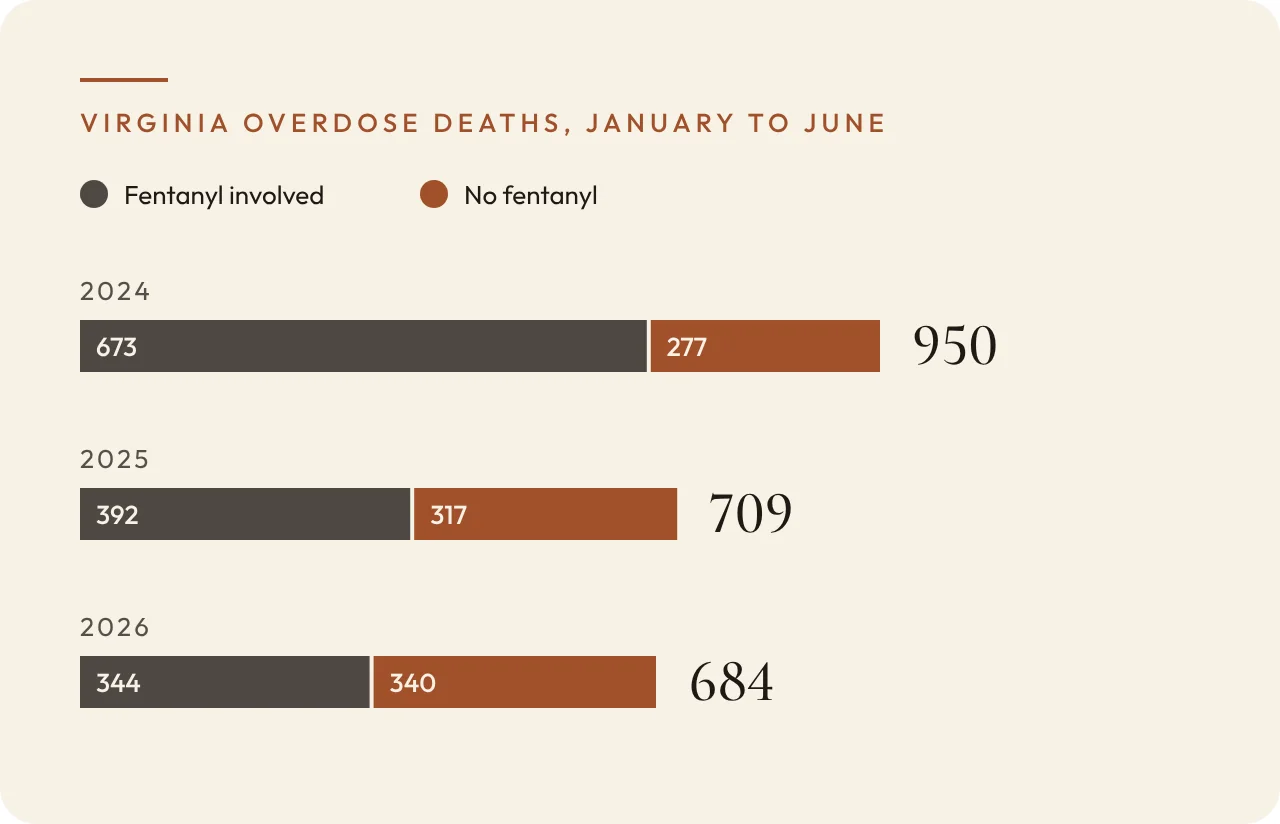
The report does not say why. It does describe 2025: fentanyl was involved in 53.1 percent of all overdose deaths. The most common combination was cocaine and fentanyl, at 23.9 percent. Nearly 60 percent of cocaine overdose deaths also included fentanyl.
For a family, that is the practical point: someone who uses cocaine, methamphetamine or pills from a friend is not safe because they “do not do opioids.” Our guides to meth and cocaine use and fentanyl and opioids explain how a mixed supply changes the risk.
When the numbers stop falling, I do not read it as failure. I read it as a sign that the easier progress is behind us. What is left is harder to reach: the person who has already had a close call and still tells the family they have it handled.
How are Richmond and Northern Virginia doing?
Northern Virginia has the clearer local numbers, and a county that urges caution. In Richmond, the response this fall has been to put naloxone in more hands.
In Northern Virginia, Fairfax County reported in June that the Fairfax Health District recorded 56 fatal opioid overdoses in 2025, down 22 percent from 72 in 2024 and 52 percent below the record of 117 in 2023. It was the lowest total since 2015, and emergency room visits for nonfatal opioid overdoses fell from 290 to 244. The county’s own caution came in the same release: “past reductions do not guarantee future decreases.”
In Richmond, the Richmond Ambulance Authority sent teams across the city on National Save a Life Day in September to hand out naloxone kits. CBS 6 reported that Robyn Hantelman, a peer recovery specialist with the authority and the statewide coordinator for the day, had more than 70 events planned. Citing the VDH dashboard, the station reported that emergency room visits for overdose among Virginians peaked at 65.1 per 10,000 visits in 2021, fell to 41.6 in 2025 and sat at 40.3 through August 2026. The same flattening, seen from the hospital door.
Where can Richmond and Northern Virginia families get naloxone?
Naloxone reverses opioid overdoses, including fentanyl. Because fentanyl so often turns up alongside other drugs, it belongs in the house even when the drug you know about is not an opioid. In Virginia it is often free.
- Your local health department. The Virginia Department of Health’s naloxone guidance for the public says many local health districts hand out kits at REVIVE! trainings, and suggests asking yours about naloxone at no cost.
- Richmond’s vending machines. The city installed free harm reduction vending machines, which offer medication to reverse opioid overdoses, in 2025 at Marshall Plaza downtown, Southside Plaza off Hull Street and the East End Library in Church Hill. In February, The Richmonder reported that three more were planned for the North Avenue, Ginter Park and Broad Rock libraries, and that the city would begin stocking test strips for xylazine, nitazene and medetomidine.
- The Richmond Ambulance Authority. CBS 6 reported that people and businesses can contact the authority’s office for a naloxone kit or a refill.
- A pharmacy. The FDA approved naloxone nasal spray for over-the-counter use in March 2023. VDH notes that pharmacists can also dispense it without a prescription under a statewide standing order.
If someone will not wake up or is not breathing normally, call 911, give naloxone and stay with them. Virginia’s safe reporting law, Code of Virginia § 18.2-251.03, protects a person who in good faith seeks emergency help for an overdose, reports one to 911, or gives care such as naloxone or CPR, from arrest or prosecution for listed offenses, including possession of a controlled substance or paraphernalia. Conditions apply: the person stays at the scene, or wherever the patient is taken, until police respond, identifies themselves to the officer, and the evidence was found because they sought help. The protection does not apply when help is sought during the execution of a search warrant or a lawful search or arrest. This is general information, not legal advice. If you are unsure whether it is an emergency, our guide to when to call 911 and when to call 988 lays out the difference. If in doubt, call 911.
Keeping naloxone at home can feel like planning for the worst. I see it the other way around. It is how a family says, we intend for you to still be here on the day you are ready to get better.
Can Virginia law make someone get treatment?
Only narrowly, and usually not for drug or alcohol use alone.
Virginia’s emergency custody order (ECO) and temporary detention order (TDO) are built around mental illness. Under Code of Virginia § 37.2-808, a magistrate may issue an ECO on the sworn petition of any responsible person or treating physician when there is probable cause to believe the person has a mental illness and, as a result of it, there is a substantial likelihood that in the near future they will cause serious physical harm to themselves or others, as shown by recent behavior causing, attempting or threatening harm, or suffer serious harm because they cannot protect themselves or provide for their basic human needs. The person must also need hospitalization or treatment and be unwilling or unable to volunteer for it.
The definitions section, § 37.2-100, defines “mental illness” and “substance abuse” as separate terms. A drinking or drug problem without a qualifying psychiatric condition generally will not support an ECO or TDO. When psychosis, mania or suicidal thinking comes with it, the mental health side may meet the test. Our guide to mental health intervention in Virginia walks through the ECO, the TDO and the commitment hearing step by step. This is general information, not legal advice; when a hearing is coming, speak with a Virginia attorney.
For most families facing addiction, the realistic path is voluntary, and a planned family intervention builds it: one rehearsed conversation, one agreed message, a bed already waiting.
Families here often arrive with a list of programs a friend recommended. We start somewhere else: what does this person need, medically and emotionally, right now? The program comes after that answer, and so does the conversation.
What should a Virginia family do this month?
Treat the plateau as a reason to act, not to wait for next quarter’s numbers.
- FirstGet naloxone into the house and the car, and make sure every adult knows where it is.
- SecondStop sorting the risk by drug. If your person uses anything bought outside a pharmacy, plan as though fentanyl could be in it.
- ThirdWrite down what you have seen, with dates. Specifics help any clinician, and they matter if a crisis ever brings you before a magistrate.
- FourthLine up a treatment option that fits the clinical need before anyone is asked to say yes.

G3 Recovery Interventions and Consulting is based in Austin, Texas, and works with families across the Commonwealth. Read how we work as a professional interventionist in Virginia, or, if the substance is alcohol, see our page on alcohol intervention for Richmond families. If a psychiatric crisis is part of it, see mental health intervention across Virginia. Because G3 accepts no referral fees, our treatment navigation is matched to the clinical need and your budget, and family consulting keeps everyone on the same page. When the answer is yes, sober transport gets your person to the door. None of this guarantees an outcome. It gives a yes somewhere to go.