
NYC Overdose Deaths Fell to Their Lowest Since 2019. The Drug Supply Did Not Get Safer.
New York City lost 1,873 people to overdose in 2025, hundreds fewer than the year before. The city’s new data brief also finds a veterinary sedative in one overdose death in ten, and the state widened its commitment standard last year. Here is what both mean for a family.
What did New York City report about overdose deaths?
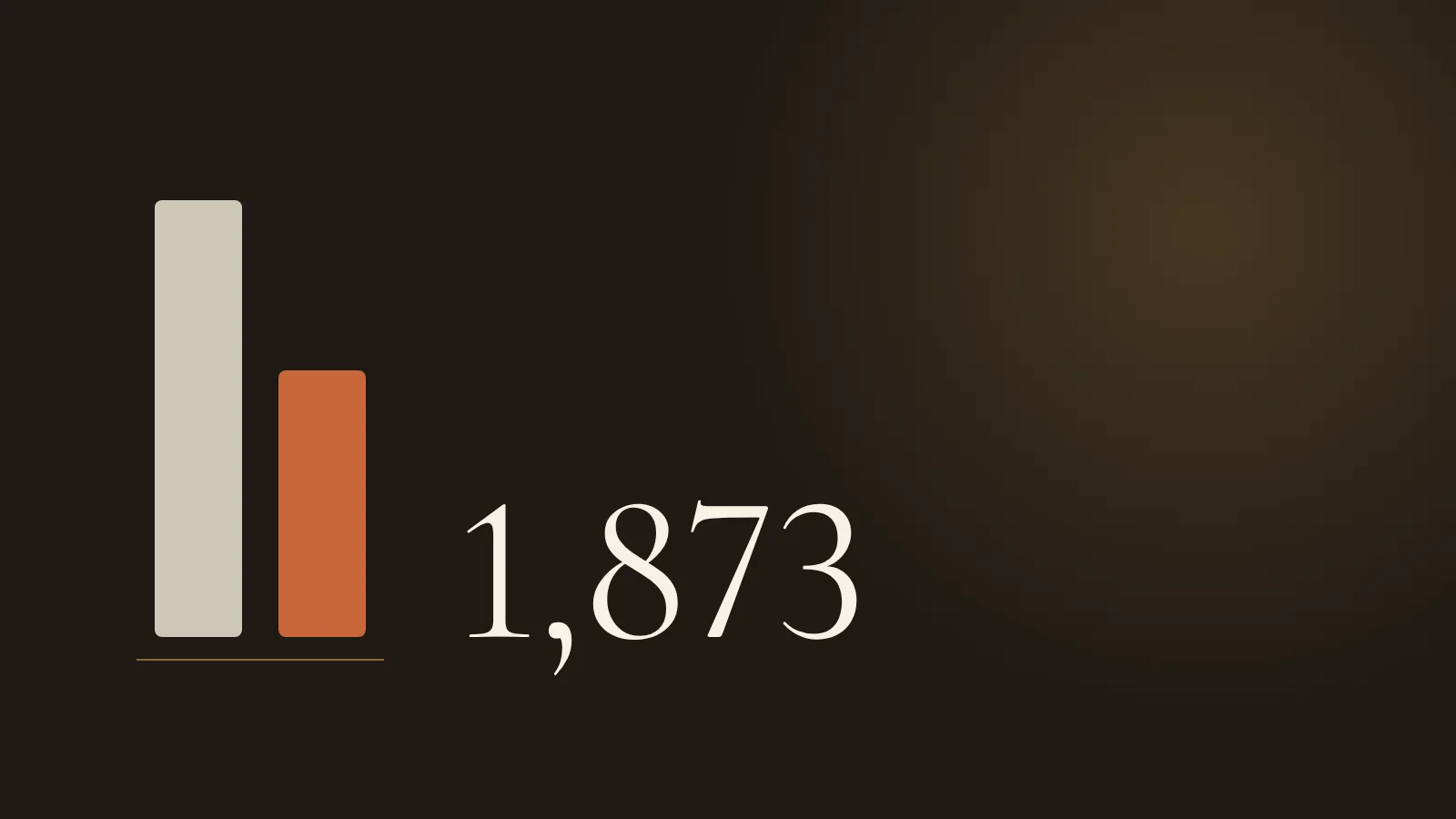
NYC overdose deaths fell to 1,873 in 2025, down 15 percent from 2,206 in 2024 and 39 percent from the 2022 peak of 3,070, according to the New York City Department of Health and Mental Hygiene. On November 12, 2026, Mayor Zohran Mamdani announced that deaths had reached their lowest levels since 2019.
The Mayor’s November 12 release reported 359 deaths in the second quarter of 2026, down from a record 859 in the last quarter of 2022. “Every overdose death is a life lost, and a reminder of the work we still have to do,” Mayor Mamdani said.
The Health Department’s new Epi Data Brief No. 165 (provisional 2025 data) keeps the news in proportion: deaths “have not returned to pre-pandemic levels and remain high: someone dies of an overdose every five hours in NYC.”
Is the decline the same in every borough?
No. The gaps between boroughs are still wide. The death rate fell about 30 percent in Manhattan and 24 percent in Queens, but only 15 percent in the Bronx and 8 percent in Brooklyn. Staten Island was flat, at 20.4 per 100,000 residents in 2024 and 20.5 in 2025.
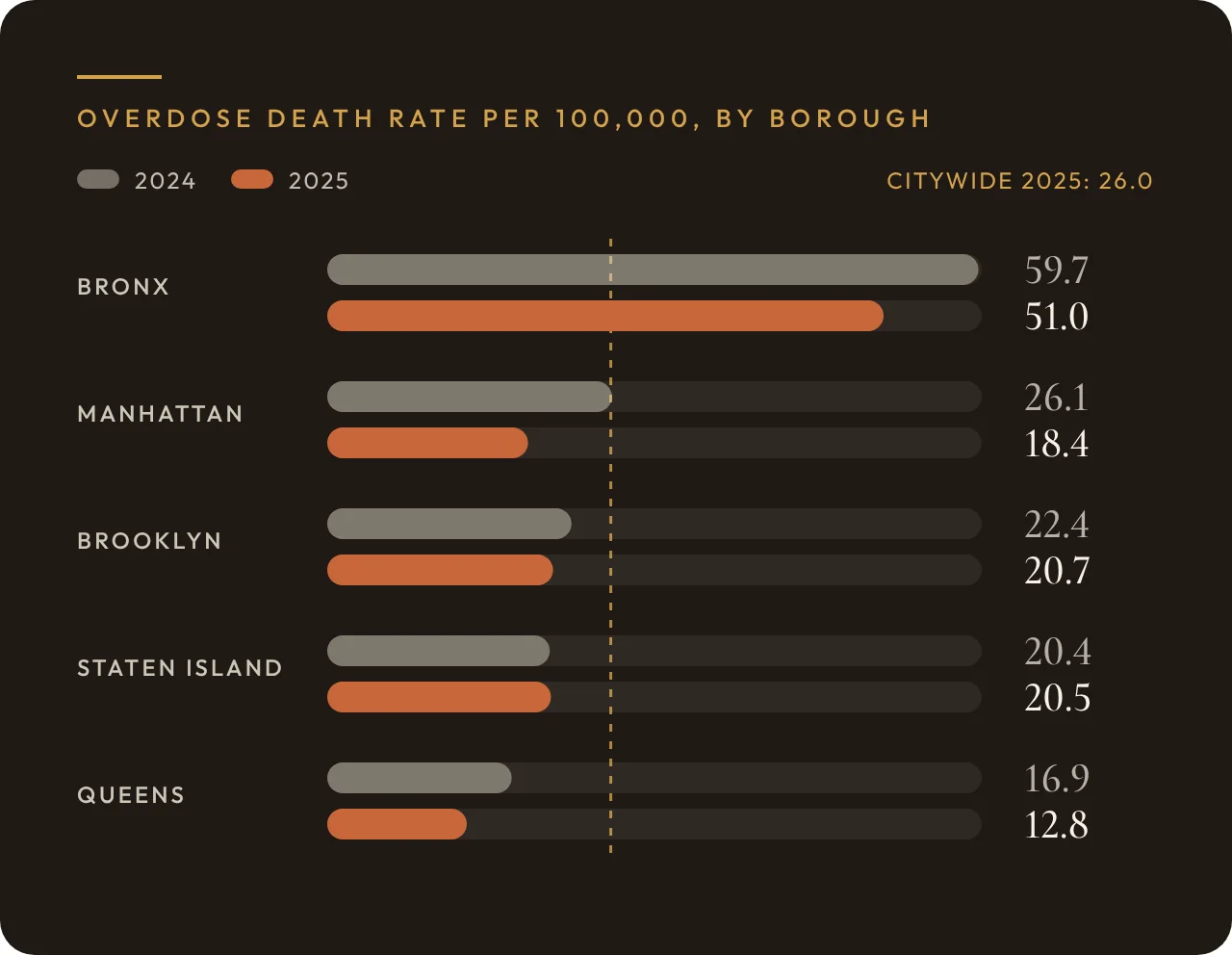
The Bronx rate of 51.0 is roughly double the citywide 26.0, and four of the five neighborhoods with the highest rates are in the Bronx; the fifth is East Harlem. New Yorkers aged 55 to 64 had the highest rate of any age group.
One detail matters more to families than any ranking: 1,107 of the 1,873 deaths happened in a private home. Most deaths here happen behind a front door, where a parent, partner or roommate may be the only person close enough to help.
A citywide number is a fair way to measure a city. It is a poor way to measure a household. The parents I talk to are not reading data briefs. They are listening at a bedroom door, and what they hear there is the only measure that counts that night.
What is medetomidine, and why is it in the report?
Medetomidine is an animal sedative, not an opioid. The New York State Department of Health calls it “a highly potent synthetic veterinary sedative not approved for human use.” It turned up in 37 percent of opioid samples checked in October 2025, compared with 4 percent in May 2024, most often mixed with fentanyl.
In the city’s 2025 data, medetomidine was involved in 181 deaths, about one in ten, and in 13 percent of opioid overdose deaths. Systematic testing began only in October 2024, so the brief cautions against comparing the 2025 count with 2024.
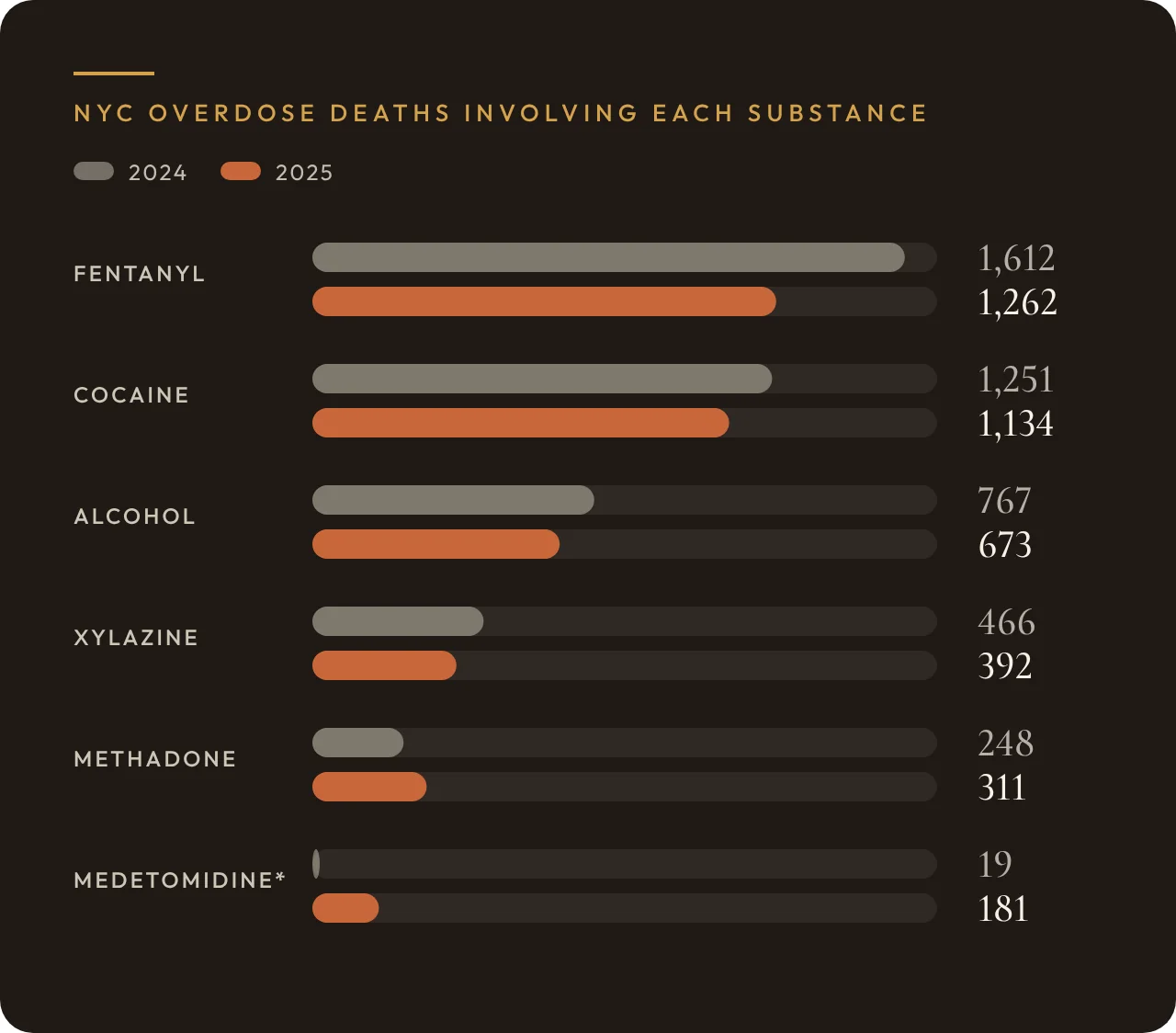
The chart holds a second lesson: cocaine was involved in 61 percent of 2025 deaths, a share the brief says has risen steadily since 2022, and alcohol in 36 percent. Because one death can involve several substances, the figures describe a mixed supply rather than a single drug. Our family guide to fentanyl and opioids explains why a mixed supply raises the stakes.
For families, medetomidine changes two things. In an emergency, the State Health Department says to give naloxone to anyone suspected of overdosing, to reverse the fentanyl and restore breathing, and to call 911. And when someone stops using, the department links medetomidine to “severe withdrawal symptoms beyond those with opioids,” while noting that New York has so far seen few reports of severe withdrawal. State Health Commissioner James McDonald warned that it “can lead to extreme vomiting and high blood pressure potentially requiring ICU care.” That makes choosing a detox setting a medical question, not a scheduling one.
When a family tells me what their person has been using, my first question to any program is whether it is ready for that withdrawal. A bed is only a bed if the people around it know what someone is coming off of. We ask that before the yes, not after.
What did New York change about involuntary commitment?
It widened the meaning of serious harm, through language in the FY 2026 budget signed by Governor Kathy Hochul on May 9, 2025.
The definition now sits in Mental Hygiene Law section 9.01, revised August 8, 2025. It covers a substantial risk of physical harm to the person, shown by threats of or attempts at suicide or serious bodily harm, or other conduct showing the person is dangerous to themself; a substantial risk of physical harm to others, shown by homicidal or other violent behavior that places them in reasonable fear of serious physical harm; and, the new third part, “a substantial risk of physical harm to the person due to an inability or refusal, as a result of their mental illness, to provide for their own essential needs such as food, clothing, necessary medical care, personal safety, or shelter.”
That third part reaches the person many families describe: not violent, not talking about suicide, but no longer eating, refusing medical care or unable to keep themselves safe. Our page on mental health intervention in New York explains how these laws fit around a planned family approach, and how involuntary commitment really works covers the process. This is general information, not legal advice.
Does the new standard reach addiction?
Not by itself. Section 9.01 ties the essential needs standard to “their mental illness.” Drinking or drug use alone does not meet it, though a co-occurring psychiatric condition can change the picture. Our dual diagnosis guide explains that overlap.
For alcohol and drugs, the main emergency provision is Mental Hygiene Law section 22.09. A person who appears incapacitated by alcohol or substances “to the degree that there is a likelihood to result in harm to the person or to others” may be taken to a treatment facility by a police or peace officer, or by the director of community services or a designee. A physician must examine them within twelve hours. They must be released once no longer incapacitated to that degree, and may not be held against their objection beyond seventy-two hours.
That is a crisis bridge, not a treatment order. It cannot choose a program, arrange insurance or persuade someone to stay, which is why many families start with a planned family intervention and hold the law in reserve for genuine emergencies.
New York’s law gives a family a door to knock on in an emergency. It does not give them a plan. Seventy-two hours goes quickly. I would rather a family walk into that window already knowing which program, which bed and which conversation comes next.
What should a New York family do this week?
- FirstKeep naloxone at home and tell every adult where it is. If someone is unresponsive, call 911, give naloxone and stay with them, even if they do not wake.
- SecondWrite down what you have seen, with dates: what is being used, missed meals, missed medical care. Every clinician you talk to will work from specifics.
- ThirdAsk any program how it handles withdrawal from fentanyl mixed with sedatives, and whether it treats mental health conditions too.
- FourthAgree as a family on what you will say and what happens the moment the answer is yes.
To talk to someone tonight, the state’s HOPEline, run by the Office of Addiction Services and Supports (OASAS), answers at 1-877-8-HOPENY (1-877-846-7369) or by text to HOPENY (467369). In a mental health or substance use crisis, call or text 988; our guide to when to call 911 and when to call 988 lays out the difference.

G3 Recovery Interventions and Consulting is based in Austin, Texas, and travels to families across New York, from the five boroughs to Long Island and upstate. Read how we work as a professional interventionist in New York. Because G3 accepts no referral fees, our treatment navigation is matched to the clinical need and your budget, and family consulting keeps everyone on the same plan. When the answer is yes, sober transport gets your person to the door. None of this promises an outcome. It means a yes has somewhere to go.