
King County Overdose Deaths Are Down in 2026. What Ricky’s Law Means for Seattle Families Now.
King County recorded far fewer overdose deaths in the first seven months of 2026 than a year earlier, and Washington’s statewide count is falling too. On July 1, Ricky’s Law, the state’s involuntary treatment law for drugs and alcohol, also reached a date state guidance had set years ago. Here is what both mean for a family worried about one person.
What do the newest King County overdose numbers show?
King County overdose deaths are falling in 2026. Figures cited by the King County Prosecuting Attorney’s Office and reported by KIRO 7 counted 446 confirmed fatal overdoses through July, compared with more than 600 in the same months of 2025. Statewide, CDC estimates 2,522 Washington overdose deaths in the year ending June 2026, down 20 percent from a year earlier.
KIRO 7 reported on September 30, in a story drawn from the King County Prosecuting Attorney’s Office, that public health data counted 446 confirmed drug overdose deaths in the county through July, against more than 600 over the same months last year. The prosecutor’s office credited expanded treatment services and wider access to naloxone.
That is real progress. It is also 446 people in seven months.
How does Washington compare with a year ago?
Washington is improving, from a very high peak. The newest provisional estimates from the CDC’s National Center for Health Statistics, based on data available as of November 1, 2026, put Washington’s overdose deaths at 2,522 for the 12 months ending June 2026. The same measure stood at 3,152 a year earlier and at 3,570 for the year ending February 2024, the highest point in the series.
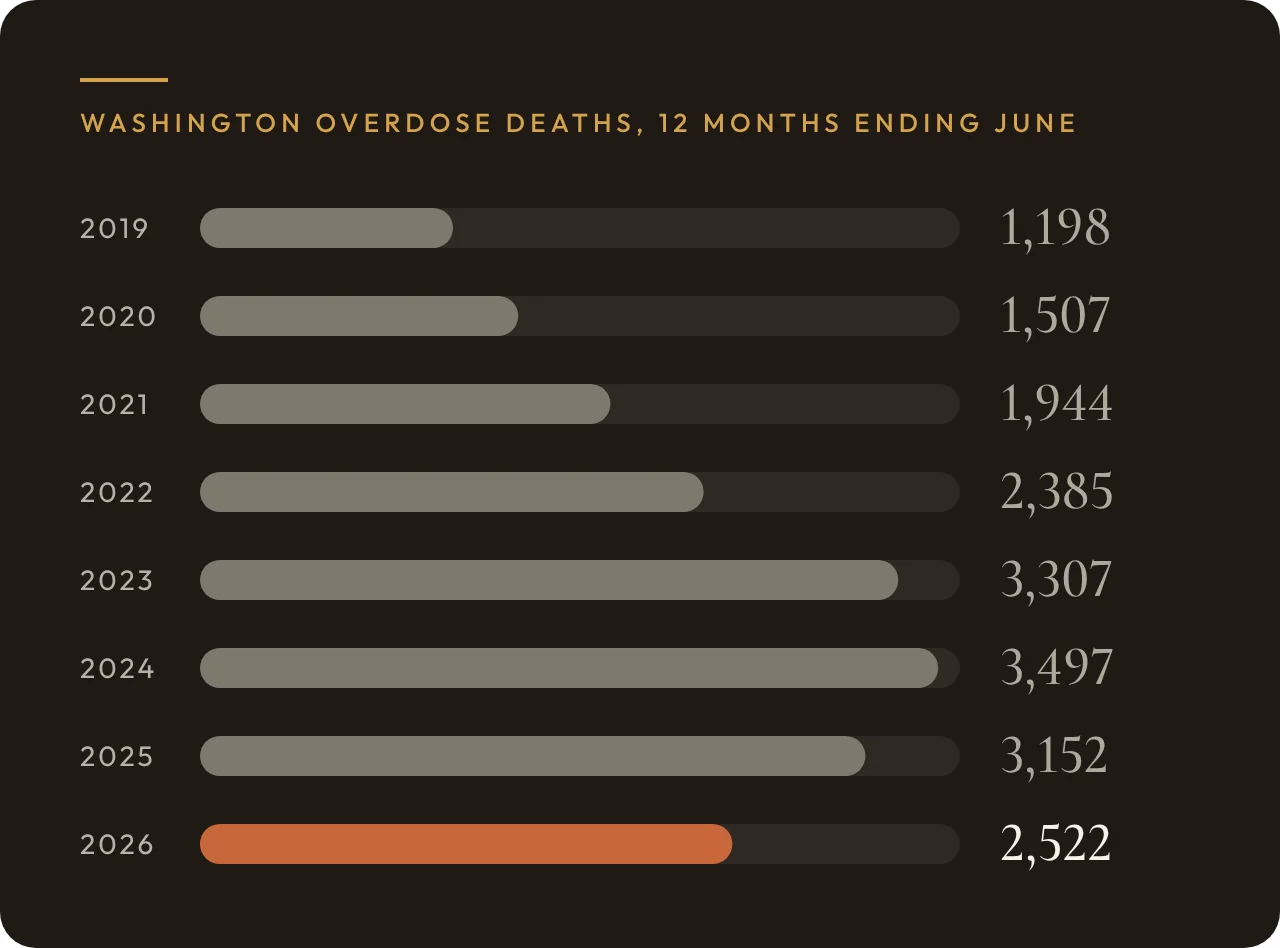
The newest estimate is 975 deaths lower than two years earlier, and still more than twice the 1,198 estimated for the year ending June 2019.
The trend describes the supply and the services around you. It cannot tell you how close one person in your home is to the edge.
What is driving overdose deaths in King County?
Mostly fentanyl and methamphetamine. County officials told KIRO 7 that the two drugs remain involved in most of the deadly cases. King County Prosecutor Leesa Manion, describing how hard fatal overdose cases are to investigate and charge, put it simply: “There are lots of different ways that people die of overdose.”
Fewer deaths has not meant fewer emergencies. Front-line workers in the busiest areas told KIRO 7 that overdose encounters remain constant. “It’s still loss of life and that hurts,” said Shonda Perez, who works at a Belltown charity.
A relative who uses meth may not think of themselves as someone at risk from an opioid. Because officials named fentanyl alongside meth in most fatal cases, naloxone belongs in any home where someone uses drugs, whatever the drug. Our family guides to fentanyl and opioids and to meth and cocaine explain what each tends to look like.
Under a statewide standing order from the Washington State Department of Health, pharmacies can dispense naloxone to anyone at risk of an opioid overdose and to family or friends who might help, with no age restriction, and residents can request free naloxone by mail. If someone is unresponsive or not breathing normally, call 911, give naloxone and stay with them.
Families tell us they noticed the change in sleep, money and mood long before anyone used the word overdose. Trust what you noticed. Write it down with dates, because it is exactly what you will be asked to describe when you reach out for help.
What is Ricky’s Law, and what changed in July 2026?
Ricky’s Law is the 2016 Washington law that brought substance use disorders into the state’s Involuntary Treatment Act. According to the Washington State Institute for Public Policy (WSIPP), it created designated crisis responders and secure withdrawal management and stabilization facilities, often called secure detox, and the first two of those facilities opened in April 2018.
The law had a practical limit. WSIPP reported in 2021 that crisis responders could not detain a person for a substance use disorder when no involuntary treatment bed was available, and that hospitals could not use single bed certification for those patients but would be able to starting in 2026. The Washington State Health Care Authority (HCA) set the date in its 2024 guide to acute care and involuntary treatment: “Single bed certification will not be available for individuals detained due to substance use disorder until July 1, 2026.”
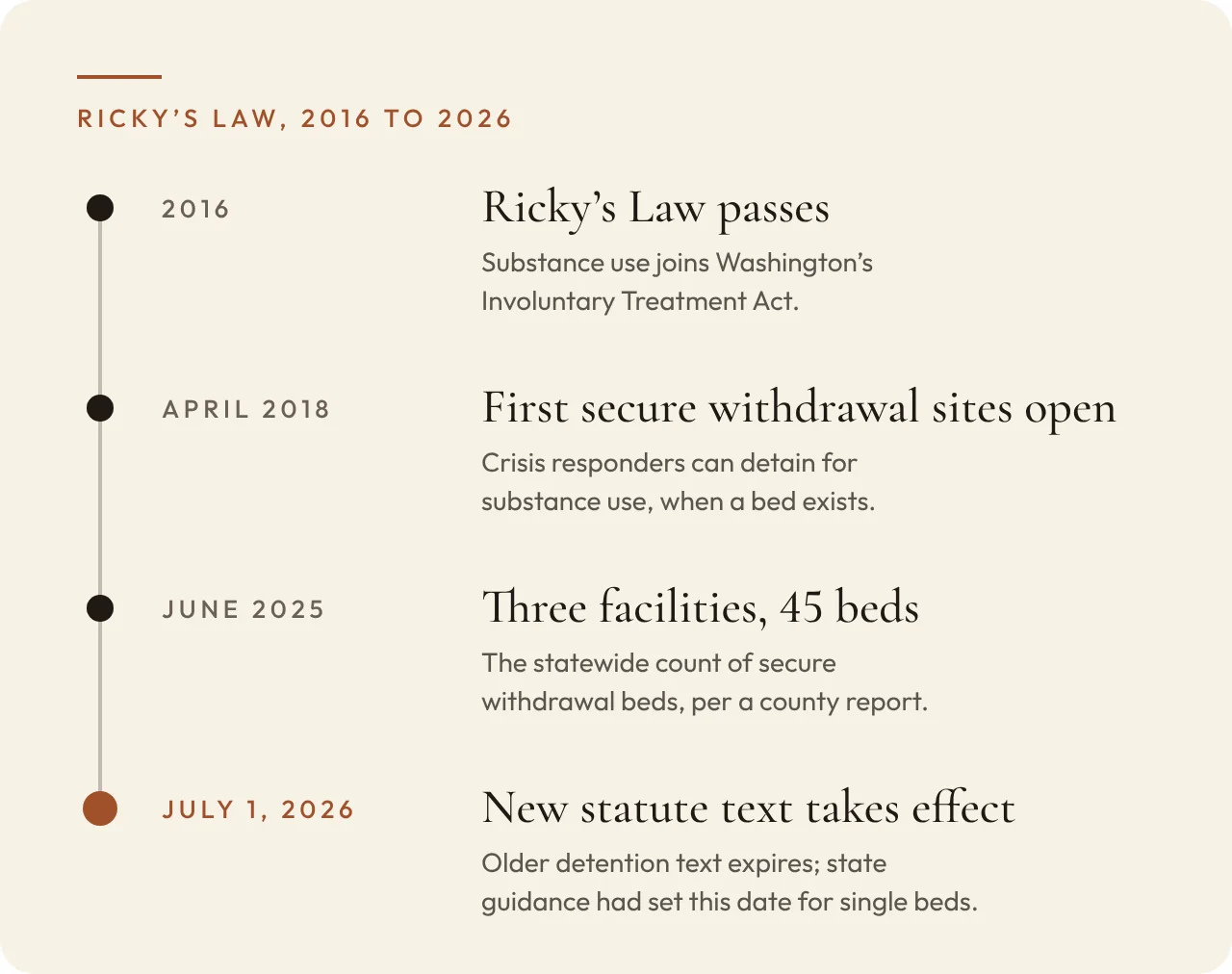
The current version of RCW 71.05.150, the initial detention statute, applies because the earlier version expired on July 1, 2026. It lists a secure withdrawal management and stabilization facility, or an approved substance use disorder treatment program, as a place where a person may be detained for up to 120 hours for evaluation and treatment, and it attaches no condition about whether a bed is open.
What a statute cannot do is build beds. A Snohomish County human services report, described by The Herald in July, found that “Washington state has three facilities with 45 SWMS beds total” as of June 30, 2025, with utilization between 67 and 71 percent. How the change works in practice is a fair question for your county’s crisis line. This is general information, not legal advice.
Families sometimes hope one crisis call will settle everything. A detention is short. It cannot choose the next ninety days for them. The plan for the day they walk out is still the family’s work, and it is easier done before the call than after it.
Who decides whether someone is detained in King County?
In most cases a designated crisis responder, a mental health professional trained for this work, decides whether to seek detention. In King County, that work belongs to King County Crisis and Commitment Services, which evaluates people for involuntary detention in psychiatric and secure withdrawal facilities 24 hours a day, every day of the year. The usual way in is a call to 988 or to Crisis Connections at 866-427-4747; if an evaluation is needed, the responder on duty follows up.
Under RCW 71.05.150, a responder may seek detention when a person, because of a behavioral health disorder, “presents a likelihood of serious harm or is gravely disabled,” and has refused or failed to accept appropriate evaluation and treatment voluntarily. Many people who are clearly struggling do not meet it on a given day.
When the answer is no, Washington law gives relatives a next step. Under Joel’s Law, RCW 71.05.201, if a crisis responder decides not to seek detention, or does not act within 48 hours of a request for investigation, an immediate family member, a guardian or, for tribal members, the tribe may petition the superior court directly. The petition has a 10 calendar day filing window, belongs in the county where the investigation took place or was requested, and needs a sworn declaration. Our page on mental health intervention in Washington walks through that process, and our guide to how involuntary commitment really works covers the wider picture.
When a responder says no, families often hear it as a verdict on their worry. It is not. It is a decision about one legal standard on one day. Keep your notes, keep the door open and keep building the plan, so there is somewhere to go the moment your person is willing.
What should a Seattle family do this week?
- FirstGet naloxone into the house and the car, from a pharmacy or the state’s free mail program, and tell every adult where it is.
- SecondSave the numbers before you need them: 911 for a threat to life, 988 or Crisis Connections at 866-427-4747 for a behavioral health crisis in King County.
- ThirdWrite down what you have seen, with dates. A crisis responder, a clinician and a Joel’s Law declaration all depend on specifics.
- FourthLine up a treatment option that fits the clinical need, including what follows a secure detox stay, before you ask anyone to say yes.
If you are unsure whether a moment is an emergency, our guide to when to call 911 and when to call 988 lays out the difference. If in doubt, call 911.

G3 Recovery Interventions and Consulting is based in Austin, Texas, and works with families throughout Washington. Read how we work as a professional interventionist in Washington, or, if a psychiatric crisis is part of the picture, see our page on Washington’s involuntary treatment and Joel’s Law. A planned family intervention asks for a yes before anyone asks a crisis responder or a judge. Because G3 accepts no referral fees, our treatment navigation follows the clinical need and your budget, and sober transport gets your person to the door. None of this guarantees an outcome. It gives a yes somewhere to go.