
Eleven Overdoses in Three Days in Charleston County. What Families Do Next.
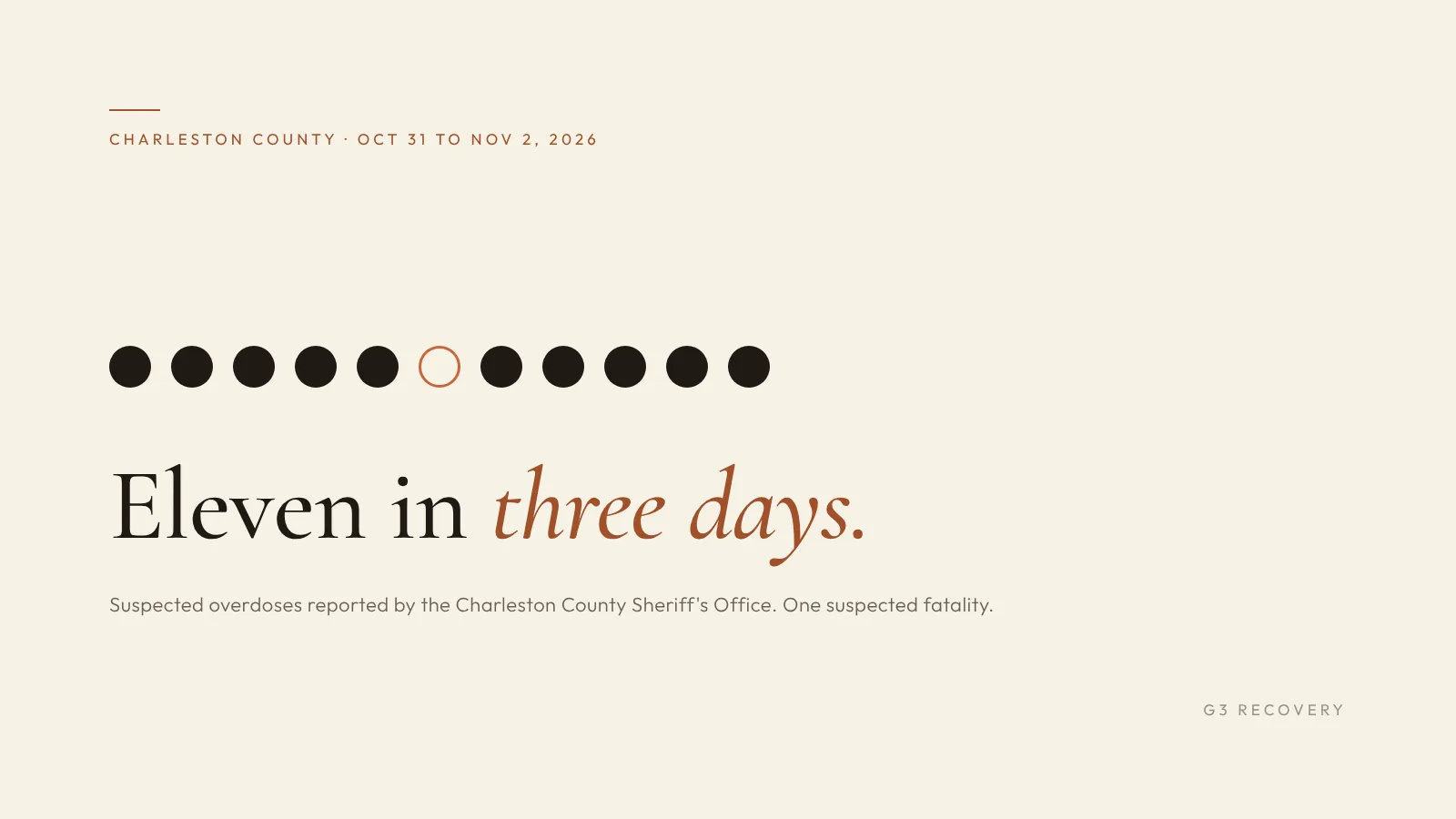
The Charleston County Sheriff’s Office counted 11 suspected overdoses in a three-day stretch that began on Halloween. One is believed to have been fatal. For families in the Lowcountry, a week like this is a reason to act on two fronts: keep someone alive today, and stop waiting on the larger conversation.
What happened in Charleston County this week?
Between October 31 and November 2, 2026, the Charleston County Sheriff’s Office reported 11 suspected overdoses, including one suspected fatal overdose. Six occurred in downtown Charleston, four in West Ashley and one in the Lincolnville area. The Sheriff’s Office urged anyone who witnesses an overdose to call 911 and give naloxone, which is free at county naloxone stands.
The Sheriff’s Office shared the figures from its overdose surveillance data and, as WCBD News 2 reported, did not release exact locations to protect privacy. Its message to the public was practical: call 911, use naloxone if you have it, and reach out to FAVOR Lowcountry, WakeUp Carolina or the Charleston Center’s Bridge2Hope app for substance use support.
Is this a spike or part of a longer pattern?
Both. Clusters like this have surfaced several times in Charleston County this year. In May, Live 5 News reported more than 10 overdoses and at least two spikes in ten days, using a working definition shared by local outreach partners: more than five overdoses within 24 hours and within a half-mile radius. In July, the Sheriff’s Office counted at least 39 overdoses in the first half of the month, seven of them fatal.
The longer trend is better than the headlines suggest. The Charleston County Coroner’s Office recorded 153 drug-related deaths in 2025, a 19 percent decrease from 2024. Statewide, the South Carolina Department of Public Health reported 1,481 overdose deaths in 2024, down 31.3 percent from 2,157 the year before. Fentanyl was involved in 914 of them.
Fewer deaths is real progress. It also means a cluster like this one stands out, and that families should read it as information about the local supply, not as background noise.
A cluster like this sends families into questions no one should have to ask. Where was he last night, who was he with, did it come from the same place. Get naloxone into the house first. Then make the call you have been putting off.
Why does naloxone in the house matter so much?
Because in most fatal overdoses, no one used it. Of the 153 drug-related deaths in Charleston County last year, naloxone was administered in 23, and bystanders gave it in 10 of those cases, according to the Coroner’s Office figures reported by Live 5. A dose in a kitchen drawer does nothing if no one nearby knows where it is.
Naloxone reverses opioid overdoses, including fentanyl, and it will not harm someone who has not taken opioids. Getting it is easier than many families realize:
- County naloxone stands. The Sheriff’s Office keeps free naloxone in public stands across the county, from downtown and West Ashley to North Charleston, Mount Pleasant, Johns Island and McClellanville. Current locations are listed in the Bridge2Hope app.
- State Opioid Overdose Safety Kits. South Carolina health departments offer free kits with two doses of naloxone, five fentanyl test strips and five xylazine test strips. DPH says you are not required to answer any questions. Call your local health department first to check availability.
- Pharmacies and community distributors. Naloxone nasal spray is sold over the counter, and JustPlainKillers.com lists free community distributors statewide.
Local trainings also cover South Carolina’s Good Samaritan law, which is worth understanding before you ever need to call. If you are unsure whether a situation is an emergency, our guide to when to call 911 and when to call 988 lays out the difference. If in doubt, call 911.
What should a Charleston family do this week?
Safety comes first. Once that is covered, a spike week is a good time to replace worry with a plan.
- FirstPut naloxone in the house and in the car, and make sure every adult knows where it is. Do this even if you believe the drug you are worried about is not an opioid. Fentanyl is often found where people do not expect it.
- SecondSave the Bridge2Hope app to your phone. It connects you to a FAVOR Lowcountry Recovery Support Specialist around the clock, along with meetings, sober living options and naloxone locations.
- ThirdWrite down what you have seen, with dates. A specific record is harder to argue with than a general fear, and it helps any professional you talk to.
- FourthAgree as a family on one message and one next step. Several relatives saying different things is the easiest response for anyone to dismiss.
A spike alert tells you the supply is dangerous this week. The more important question for a family is what has been true for the past year. If that answer worries you, it is reason enough to start planning.
What if they survived an overdose and still say no?
This is where a professional intervention fits. Most families who reach us have already tried talking. Usually it happened one relative at a time, in the middle of an argument, with no treatment option ready to accept.
An intervention changes that. The family prepares together, speaks with one voice and offers a specific treatment option that has already been arranged. Our guide to fentanyl and opioids explains why the stakes are higher than they were a decade ago, and if a mental health crisis is part of the picture, our page on mental health intervention in South Carolina covers what the law allows and where it stops.
When someone survives an overdose, the next morning everyone wants to call it a one-time thing. Those first days are when a family can still choose a different plan, and the person is often more willing to listen than they will be a month later.
G3 Recovery Interventions and Consulting is based in Austin, Texas, and travels to families across South Carolina, from Charleston and the Lowcountry to Columbia, Greenville and the coast. Read how we work as a professional interventionist in South Carolina. Because G3 accepts no referral fees, our treatment navigation is matched to the clinical need and your budget, in South Carolina or out of state. When the answer is yes, sober transport gets your person to the door. None of this guarantees an outcome. It gives a yes somewhere to go.