
Cychlorphine Has Reached Los Angeles. Fentanyl Test Strips Cannot See It.
Los Angeles County has spent three years watching overdose deaths fall. In October, Public Health confirmed the county’s first death linked to cychlorphine, an opioid stronger than fentanyl that the usual test strips miss. Both facts belong in the same conversation, along with a state law that changed for Los Angeles families in January.
What did Los Angeles County announce about cychlorphine?
On October 15, 2026, the Los Angeles County Department of Public Health reported that the Medical Examiner had linked a February 2026 death to cychlorphine, a synthetic opioid more potent than fentanyl. It was the drug’s first confirmed presence in the local supply. Fentanyl test strips cannot currently detect it.
The Public Health warning describes cychlorphine, also called N-propionitrile chlorphine, as an opioid, like fentanyl and heroin, but more potent than fentanyl, with the power to cause respiratory depression and death. The County Medical Examiner identified it in a death from February 2026, and the department called that case the first confirmed presence of cychlorphine in the local illicit drug supply. The same release notes that another cychlorphine death was reported in Northern California in April 2026.
Why can’t fentanyl test strips catch it?
Because the strips are built to find fentanyl, and cychlorphine is a different drug. Public Health says cychlorphine is currently undetectable by fentanyl testing strips and is being mixed into the drug supply without users knowing it is there.
Many families take comfort in knowing their person tests what they use. A negative fentanyl strip says nothing about whether cychlorphine is in the sample.
According to the county, cychlorphine has been known in the U.S. illicit supply since 2024 and has been detected in 19 states, in powders, counterfeit tablets, rocks or crystals, and liquids. In August 2026, the Drug Enforcement Administration classified it as a Schedule I drug, which makes it illegal to possess or sell.
A relative who buys what they believe is a prescription pill may never think of themselves as someone who uses opioids. Our family guide to fentanyl and opioids explains how a contaminated supply changes that risk.
When a family tells me their son is careful because he tests everything, I hear a family that has been handed a reason to wait. A test strip offers certainty, and certainty is exactly what this drug supply keeps taking away. Careful is not the same as safe.
Are overdose deaths in Los Angeles still falling?
Yes. The county is improving while the supply keeps changing underneath it.
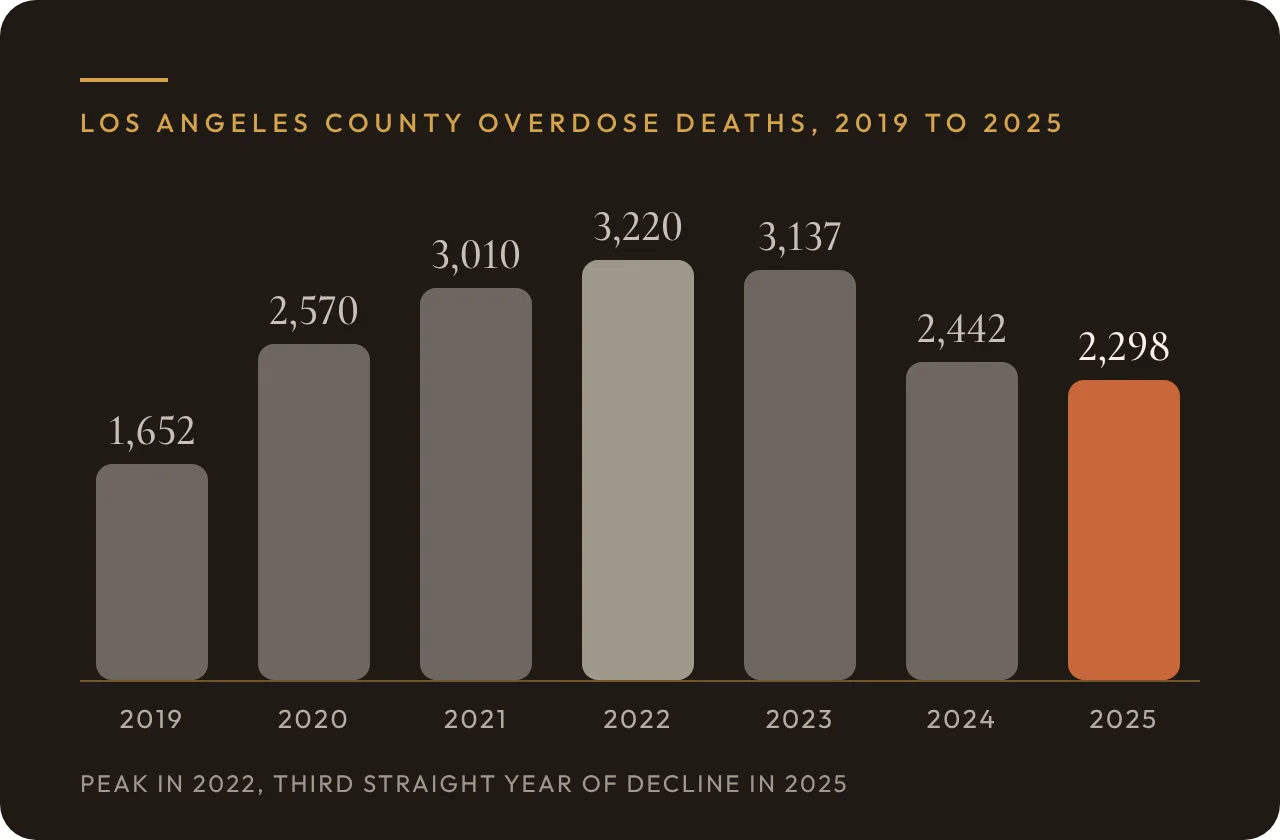
In June, Public Health reported a third straight year of decline: 2,298 overdose and poisoning deaths in 2025, down 6 percent from 2024 and nearly 30 percent below the all-time high of 3,220 in 2022. Fentanyl-related deaths fell 10 percent in 2025 and methamphetamine-related deaths fell 7 percent.
The decline has not reached everyone evenly. Deaths among adults 65 and older rose 14 percent in 2025. Adults 40 to 64 accounted for 53 percent of all deaths. Residents of high-poverty areas and Black residents had the highest overdose death rates.
The department’s full data report adds one more figure families should sit with: deaths involving both a stimulant and an opioid made up 39 percent of accidental overdose deaths in 2025. Someone whose problem looks like methamphetamine or cocaine may still be exposed to opioids. Our guide to meth and cocaine for families covers what stimulant use tends to look like at home.
What does naloxone do against an opioid this strong?
Naloxone reverses opioid overdoses, and Public Health’s guidance for cychlorphine includes it directly. The county says naloxone can be given through the nose or as an intramuscular injection, that both methods are equally effective, and that multiple doses may be necessary.
So keep more than one dose, and make sure every adult in the house knows where it is. Naloxone nasal spray has been sold without a prescription since the FDA approved it for over-the-counter use in March 2023.
The county’s other advice is direct: avoid illicit substances altogether; never use alone; start low and go slow; and do not mix opioids with alcohol, sedatives or sleeping medications. In an emergency, call 911 and give naloxone. If you are unsure whether a moment is an emergency, our guide to when to call 911 and when to call 988 lays out the difference. If in doubt, call 911.
What changed in California law for Los Angeles families this year?
In January 2026, Senate Bill 43 took effect in Los Angeles County, the Department of Mental Health confirms, widening the meaning of “gravely disabled” in California’s Lanterman-Petris-Short (LPS) Act.
Under Welfare and Institutions Code section 5008(h)(1)(A), “gravely disabled” now includes a condition in which a person, as a result of a mental health disorder, a severe substance use disorder, or both together, is unable to provide for their basic personal needs for food, clothing, shelter, personal safety or necessary medical care. Section 5008(o) defines a severe substance use disorder as a diagnosed substance-related disorder that meets the “severe” criteria of the current Diagnostic and Statistical Manual. Section 5008(h)(4) let counties defer these changes until January 1, 2026.
Two limits matter. First, families cannot start a hold themselves. The Department of Mental Health explains that a 5150 hold can be initiated by a peace officer or by a person the department has designated as an LPS-authorized individual. Second, a hold is short by design.
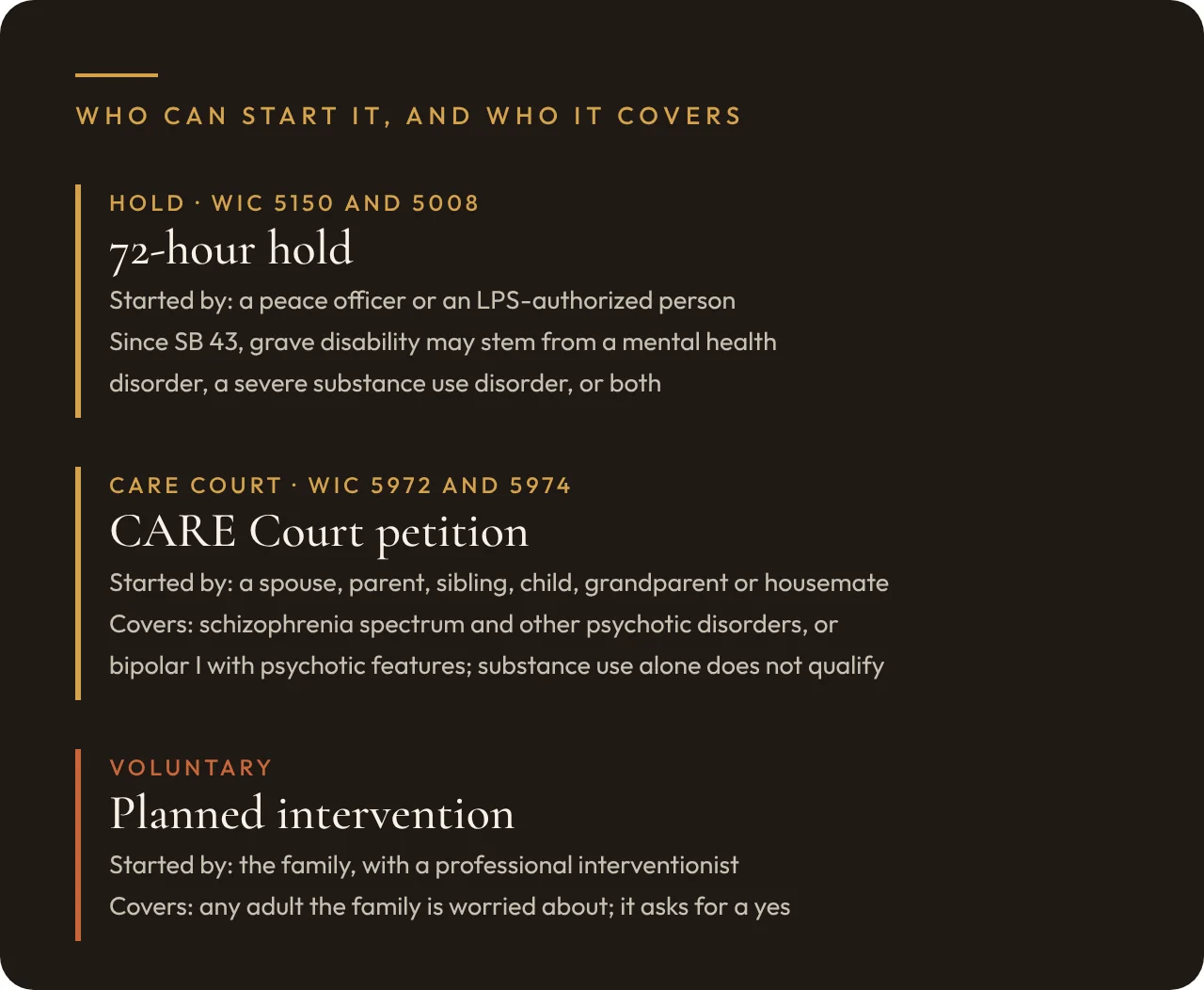
CARE Court is the other path families ask about, and it works differently. Under section 5974, a spouse, parent, sibling, child or grandparent, or an adult the person lives with, may file the petition directly. Eligibility under section 5972 requires, among other criteria, an adult currently experiencing a serious mental disorder with a diagnosis in the class of schizophrenia spectrum and other psychotic disorders, or bipolar I disorder with psychotic features. A substance use disorder alone does not qualify.
LAist reported in July that 1,111 petitions had been filed in the county since its December 2023 launch, far below the roughly 3,800 a year state officials had projected, and that petitions rose about 85 percent between November 2025 and March 2026.
Our page on mental health intervention in California covers the 5150, Laura’s Law and CARE Court in depth, and our guide to how involuntary commitment really works explains the common ground across states. This is general information, not legal advice.
Families ask whether the new law means they can finally make someone go. When the danger is real, a hold may happen, and it should. But a hold ends in days. What carries a family past it is a program already chosen and people ready to act when the doors open.
What can a Los Angeles family put in place before a crisis?
- Naloxone in two placesKeep naloxone where your person sleeps and in the car they use most, so no one has to search a drawer when minutes matter.
- A new rule about stripsTell everyone in the family, in plain words, that a negative fentanyl strip no longer rules out an opioid stronger than fentanyl.
- A record in the law’s termsKeep dated notes on what you see against the needs SB 43 names: food, clothing, shelter, personal safety and necessary medical care. If a hold is ever considered, specifics carry more weight than worry.
- Numbers saved before you need themPut 911, 988 and the county Help Line for Mental Health and Substance Use Services, (800) 854-7771, in every family phone, then choose a program before anyone is asked to say yes.
Every legal path in California ends with someone else’s decision: an officer, a clinician, a judge. An intervention starts with yours, and you can begin planning this week without waiting for anyone to call it an emergency.

G3 Recovery Interventions and Consulting is based in Austin, Texas. Preparation starts by phone and video, and Matt flies in for the intervention itself, usually into one of the state’s major airports, LAX among them. Read how we work as a professional interventionist in California, and if psychiatric symptoms are part of the picture, see our page on mental health intervention for California families. Through family consulting, Hannah helps relatives agree on one message before anyone sits down to talk. G3 takes no referral fees from any program, so our treatment navigation weighs a Los Angeles bed against one out of state on clinical need and your budget alone, and sober transport covers the trip from the front door to admission. We cannot promise how the conversation ends, only that a yes will find the bed, the ride and the people already waiting.