
Oklahoma’s Overdose Notification Law Is Now in Effect. Families Should Still Call 911.
Since November 1, Oklahoma first responders who treat a suspected overdose must also contact local law enforcement. For a family in Oklahoma City, the new rule can make an already frightening phone call feel heavier. It should not change the call itself. Here is what the law says, what it leaves alone, and what to do this week.

What does Oklahoma’s overdose notification law do?
Oklahoma’s overdose notification law, House Bill 2941, took effect November 1, 2026. A first responder who reasonably believes someone has overdosed must contact local law enforcement as soon as practicable, after attending to the person’s medical needs, and that duty does not require any delay in emergency care. Families should still call 911 right away.
The law was written by Representative Steve Bashore, a Republican from Miami, and FOX 25 reported on October 28 that it would take effect November 1. Bashore told the station that “Fentanyl is a growing problem in our state and across the nation.”
The House floor text of House Bill 2941, which the House described in the same terms when the governor signed it, does three things:
- The dutyA first responder who reasonably believes a person is experiencing or has experienced a drug overdose “shall contact local law enforcement as soon as practicable” after attending to that person’s medical needs.
- The limit“The obligation to contact law enforcement does not require delay in providing medically necessary emergency care.” A responder acting in good faith is immune from liability for making the contact.
- The presumptionIn any investigation or prosecution involving a fatal overdose, fentanyl found in the person’s blood, tissue or post-mortem toxicology is rebuttable prima facie evidence that fentanyl was the proximate cause of death.
Notice what is not in the text: nothing about the family member who dialed 911. Its subject is the responder.
Should you still call 911 if someone overdoses in Oklahoma?
Yes. Nothing in the new law changes the first and most important step: when someone will not wake up or is not breathing normally, call 911.
A parent may now think about police as well as paramedics. That deserves an answer before the night it arrives.
Start with the protection that already exists. Oklahoma’s overdose immunity statute, 63 O.S. § 2-413.1, covers a person who requested emergency medical assistance for someone who appeared to need it because of drug use, gave their full name and other information the officer asked for, stayed until help arrived, and cooperated. That person may not be taken into custody based solely on certain drug offenses, and is immune from prosecution for possessing a Schedule I or II controlled dangerous substance below trafficking amounts and related paraphernalia, where the offense involved intoxication from a controlled dangerous substance.
That protection covers possession, not every possible charge, and the new notification law did not repeal it. This is general information, not legal advice.
None of it changes the order of operations: call 911, give naloxone if you have it, and stay. MedlinePlus, from the National Library of Medicine, tells anyone who uses naloxone nasal spray to call for emergency medical assistance immediately after giving the first dose. Our guide to when to call 911 and when to call 988 covers the gray areas. If in doubt, call 911.
When someone stops breathing, there is exactly one question in the room: is help on the way? Call, give the naloxone and stay with them. Whatever else a family is afraid of in that moment can be dealt with tomorrow. The next few minutes cannot wait for it.
Why does this matter so much in Oklahoma City?
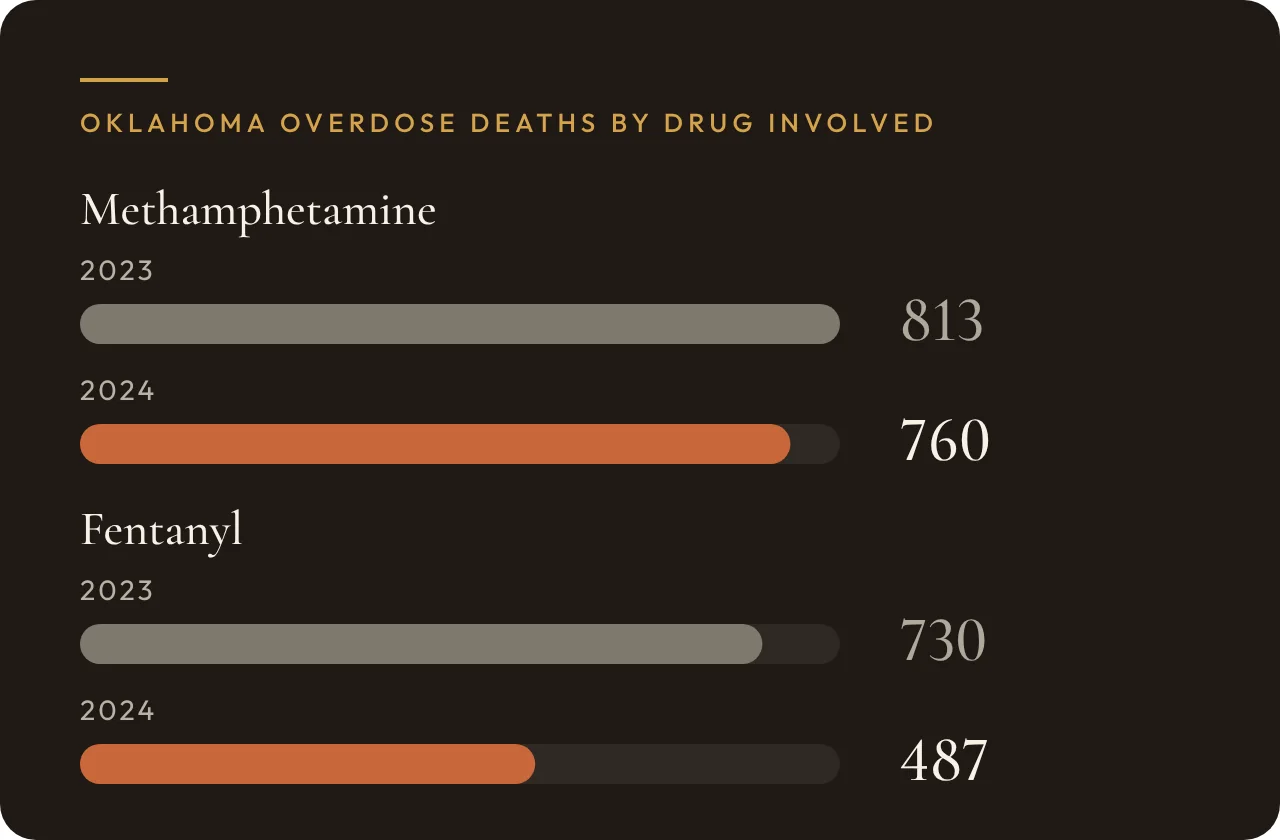
The Oklahoma State Department of Health (OSDH) reports that fentanyl deaths rose from 127 in 2020 to 730 in 2023, then fell 34 percent to 487 in 2024. Fentanyl was involved in 86 percent of opioid-related overdose deaths in 2024, compared with roughly 10 to 20 percent a year before 2020. Methamphetamine is the larger story here: deaths rose to 813 in 2023 and fell 7 percent to 760 in 2024, and methamphetamine was involved in about two of every three overdose deaths in 2024.
When fentanyl turns up in other drugs, people who would never call themselves opioid users carry opioid risk anyway. Our family guides to meth and cocaine and to fentanyl and opioids explain what each looks like at home.
OSDH’s Oklahoma County fact sheet, dated April 2026, counts 1,186 unintentional drug overdose deaths among county residents from 2020 through 2024. The county’s drug overdose death rate increased 87 percent, from 15.7 per 100,000 in 2015 to 2019 to 29.4 per 100,000 in 2020 to 2024.
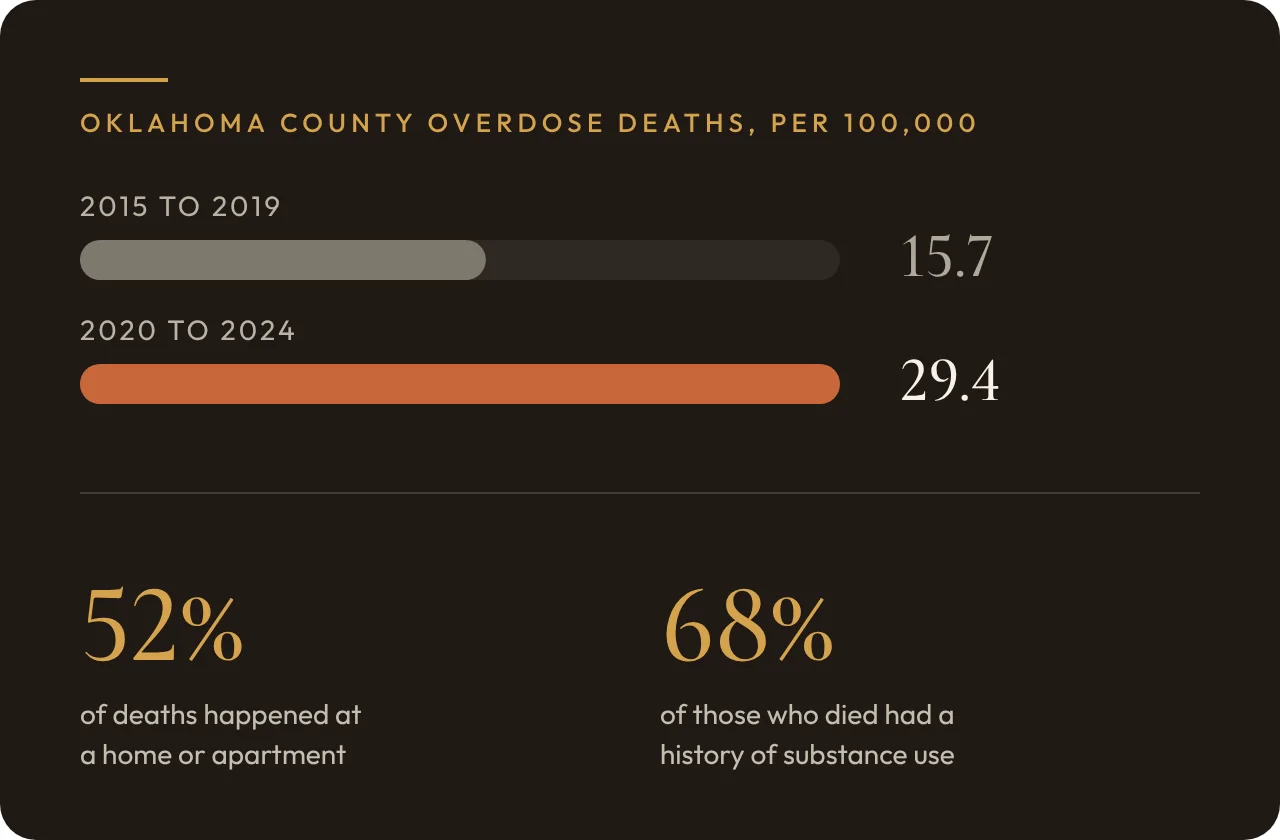
Two other lines matter most to families. Fifty-two percent of the deaths occurred at a home or apartment, and 68 percent of the people who died had a history of substance use. Most of these deaths did not come out of nowhere.
Families sometimes wait for something outside the house to make the decision for them: a new law, a court date, a crisis big enough that a stranger has to act. I understand the wish. But the most useful decisions get made at the kitchen table, together, before the next emergency, while everyone can still think.
Where can Oklahoma City families get naloxone?
Used along with emergency medical treatment, naloxone nasal spray can reverse the life-threatening effects of an opioid overdose, and fentanyl is an opioid. It belongs in the house even when the drug you know about is methamphetamine.
- By mail, free. The Oklahoma Department of Mental Health and Substance Abuse Services (ODMHSAS) runs OK I’m Ready, where you can order one or two naloxone kits to an Oklahoma address. The site warns that fulfillment may be delayed, so order before you need it.
- At a pharmacy. The same site notes that naloxone “is available at many pharmacies with no Dr. visits required.” Fentanyl test strips are no longer mailed, though the site says pharmacies carry them too and links a locator for both.
What can an Oklahoma family do when a loved one refuses help?
Oklahoma’s mental health and substance abuse law, Title 43A, lets close relatives go to court directly.
Under 43A O.S. § 5-410, “the father, mother, husband, wife, grandparent, brother, sister, guardian or child, over the age of eighteen (18) years, of an individual alleged to be a person requiring treatment” may file, or ask the district attorney to file, a petition with the district court. The court decides whether the person requires treatment and orders the least restrictive appropriate treatment. The petition must state the facts behind it and is made under penalty of perjury.
The definition matters. Under 43A O.S. § 1-103, a person requiring treatment is someone who, “because of his or her mental illness or drug or alcohol dependency,” meets at least one test, such as posing “a substantial risk of immediate physical harm to self,” posing that risk to another person, or being “in a condition of severe deterioration that is continuing, as has been observed within the previous seventy-two-hour period.” Addiction counts, but history alone does not: the statute says a person’s substance abuse history “shall not be the sole basis” for the decision.
For protective custody and emergency detention, our page on mental health intervention in Oklahoma explains the steps and time limits, and our guide to how involuntary commitment really works gives the broader picture. This is general information, not legal advice; talk with an Oklahoma attorney before filing.
Oklahoma families are good at showing up for each other in a crisis. The harder work is showing up the same way on an ordinary Tuesday, before anything has happened. That is when we like to start, because that is when everyone can still listen.
What should an Oklahoma City family do this week?
- FirstGet naloxone into the house, and tell every adult where it is.
- SecondAgree as a family that whoever finds an overdose calls 911, gives naloxone and stays, so no one hesitates in the moment.
- ThirdWrite down what you have seen, with dates. Specifics help any professional, and a court petition asks for them.
- FourthLine up a treatment option that fits the clinical need, including any mental health symptoms, before you ask anyone to say yes.

G3 Recovery Interventions and Consulting works with Oklahoma families from Austin, Texas, and our guide to interstate intervention logistics explains how travel and timing work. Read how we work as a professional interventionist in Oklahoma, or see our pages on drug intervention for Oklahoma City families and alcohol intervention in Oklahoma City. A planned family intervention asks for a yes before anyone asks a judge. Because G3 accepts no referral fees, our treatment navigation follows the clinical need, and sober transport gets your person to the door when the answer is yes. None of this guarantees an outcome. It gives a yes somewhere to go.